
84% of Organizations Have Not Redesigned a Single Job Around AI
Organizations are investing heavily in AI training, but integration is the real measure of success.



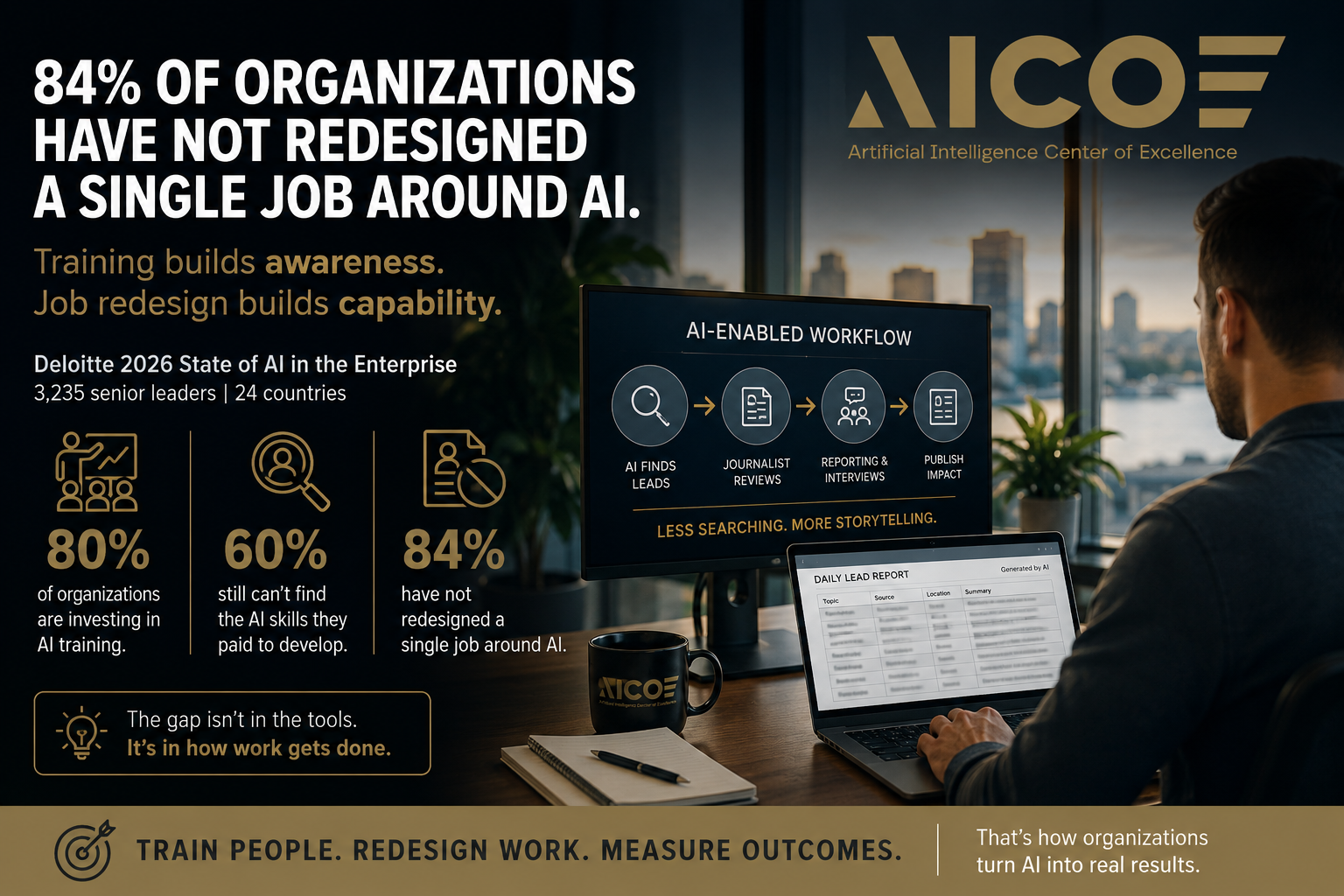
According to Deloitte's 2026 State of AI in the Enterprise, based on responses from 3,235 senior leaders across 24 countries, eight in ten enterprise organizations are paying for AI training. Yet six in ten still report they cannot find the AI skills they need. One statistic stands above the rest: 84% of organizations have not redesigned a single job around AI.
That finding explains why so many AI initiatives stall after the excitement of a workshop.
Training introduces people to new tools. Job redesign changes how work gets done.
Many organizations measure success by counting employees who attended a class, completed a certification or experimented with ChatGPT. Those metrics describe learning activity. They say very little about whether the organization itself has changed.
Even when an individual discovers a better way to work, the improvement often stays with that person. One employee builds an AI workflow. Another continues using the old process. A third creates a different approach altogether. The organization now has three ways to perform the same task.
That inconsistency limits the value of AI. It can also create additional work as employees spend time translating between different processes, formats and expectations.
The organizations seeing the greatest gains are redesigning the work itself.
That means asking practical questions.
Should this role begin each day with an AI-generated briefing?
Should research be collected automatically instead of manually?
Should first drafts always begin with AI before human editing?
Should recurring reports be generated by AI with staff focused on review and judgment?
Those decisions belong in documented workflows, standard operating procedures and job descriptions. They should not depend on whether one employee happens to enjoy experimenting with AI.
At the St. Pete Catalyst, we use AI to search public records, press release sites and social media every morning to identify potential news leads. Those leads are organized into a spreadsheet before our journalists begin their day.
The value is not that one reporter learned a new AI tool.
The value comes from redesigning the workflow for everyone on the editorial team. Journalists spend less time searching for stories and more time reporting, verifying and interviewing. The process is consistent, repeatable and continually improving.
That is organizational capability.
Leaders should also examine the signals they are sending through hiring.
How many positions has your organization created specifically because AI makes new work possible?
How many existing job descriptions have been updated to include AI responsibilities?
Are candidates evaluated on their ability to use AI within your organization's workflows, or are you still hiring for the same role you defined five years ago?
Those questions reveal far more about AI readiness than the number of employees who attended training.
Every major technology wave eventually changes organizational structure. Personal computers created IT departments. The internet created digital marketing teams. Cloud computing created DevOps and cloud architecture roles.
AI will reshape work in the same way.
Organizations that redesign roles and workflows will build institutional capability. Organizations that stop at training will continue wondering why the promised productivity gains never seem to arrive.
A Practical Model for Moving Beyond AI Training
Redesign one role. Select a high-volume position and document where AI should become part of the standard workflow.
Standardize the process. Turn successful individual practices into shared procedures, templates and operating guides that everyone follows.
Hire for the new role. Update job descriptions and interview processes so new employees arrive with the capabilities the redesigned role requires.
Measure operational outcomes. Track hours saved, cycle times, quality improvements and throughput instead of counting training completions.
The organizations that pull ahead over the next few years will not be the ones that trained the most employees. They will be the ones that systematically redesigned how work gets done.


%2FNegative.svg)
