
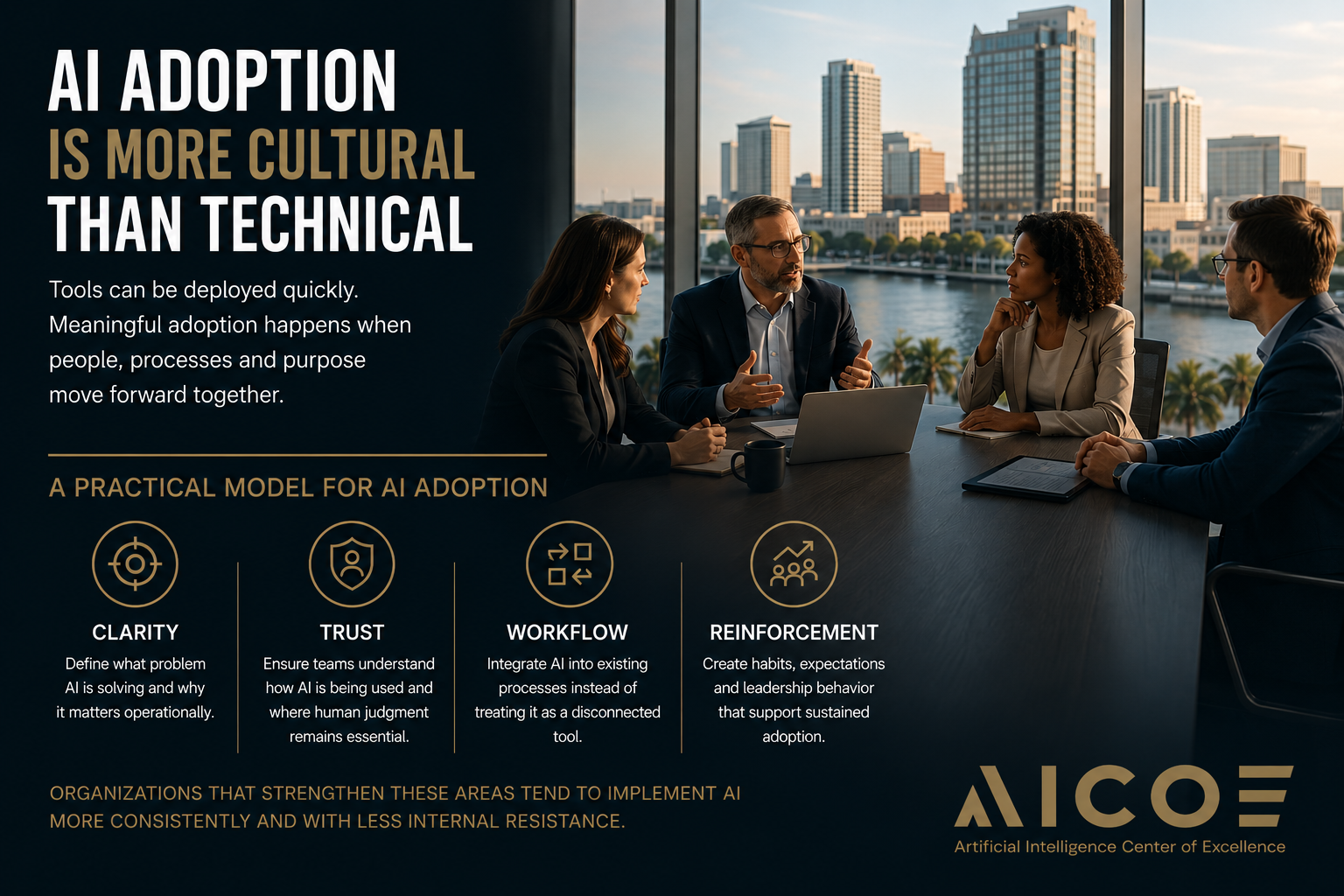
AI Adoption Is More Cultural Than Technical
Most organizations do not struggle with AI because the tools are weak. They struggle because implementation requires changes in behavior, trust and operational habits.




Artificial intelligence discussions often begin with technology and end with technology. Organizations evaluate models, compare tools and debate capabilities as if adoption were primarily a software decision.
In practice, most implementation problems emerge somewhere else entirely.
Organizations rarely fail to adopt AI because the systems are incapable. They fail because workflows, incentives and organizational habits are difficult to change. The technical layer moves quickly while the human layer moves more slowly and with greater resistance.
This creates confusion for leaders. They see impressive demonstrations of AI capability, then wonder why implementation inside their own organization feels uneven, slow or fragmented.
The answer is usually cultural before it is technical.
AI changes how work gets done. That means it also changes how decisions are made, how teams interact and how people perceive their own value inside an organization.
Those are cultural questions.
When employees feel AI is being imposed without clarity, adoption slows. When workflows remain unchanged, tools become disconnected experiments instead of operational improvements. When leadership treats AI as a side initiative rather than a change in organizational behavior, implementation stalls.
Many organizations are currently layering AI on top of systems and processes designed for a different era of work. That approach creates friction because the organization itself has not adapted to support the capability it is trying to deploy.
Technology can accelerate performance, but organizations still need alignment, trust and operational clarity for that acceleration to translate into results.
▌ A Practical Model for AI Adoption Inside Organizations
Clarity
Define what problem AI is solving and why it matters operationally
Trust
Ensure teams understand how AI is being used and where human judgment remains essential
Workflow
Integrate AI into existing processes instead of treating it as a disconnected tool
Reinforcement
Create habits, expectations and leadership behavior that support sustained adoption
Organizations that strengthen these four areas tend to implement AI more consistently and with less internal resistance.
This distinction matters because many leaders are operating on the assumption that better tools alone will solve adoption challenges.
In reality, organizations with average tools and strong operational alignment will often outperform organizations with advanced tools and weak internal coordination.
The gap becomes even more visible at scale. Small teams can sometimes improvise around friction. Larger organizations cannot. Without cultural alignment, implementation slows as uncertainty, inconsistent usage and competing priorities spread across departments.
For civic and business leaders, this changes how AI strategy should be approached.
The objective is not simply purchasing access to new capabilities. The objective is creating an environment where people can confidently integrate those capabilities into daily work.
That requires leadership visibility, clear communication and practical education around how AI changes workflows and expectations.
It also requires realism.
Most organizations are still early in this process. Many are experimenting without clear governance. Others are waiting too long because uncertainty feels safer than change. Neither approach creates long-term advantage.
Organizations that move effectively tend to follow a more disciplined path. They identify practical use cases, involve the people closest to the workflow and focus on measurable improvements rather than broad transformation language.
Over time, that creates organizational confidence. Confidence leads to wider adoption, and wider adoption creates operational momentum.
At a regional level, this has major implications for Tampa Bay.
Regions that treat AI as a technical specialty will concentrate capability into a small number of companies and individuals. Regions that build broad organizational fluency will create more resilient businesses, stronger institutions and a workforce better prepared for ongoing technological change.
This is one of the central reasons we are building the Artificial Intelligence Center of Excellence.
The goal is not simply increasing awareness of AI. The goal is helping organizations across the region develop the operational readiness required to use it effectively.
That includes leadership education, workforce development and practical implementation support that helps organizations move from experimentation into sustainable adoption.
The organizations that benefit most from AI over the next decade will not necessarily be the ones with the most advanced systems.
They will be the ones that learn how to align people, workflows and technology into a coherent operating model.


%2FNegative.svg)
