
AI Governance 101: The Foundation Every Small Business Should Build
AI governance is becoming a standard business practice. A simple inventory, clear policies and defined ownership give organizations a framework for adopting AI with confidence as customer expectations, vendor requirements and regulations continue to evolve.




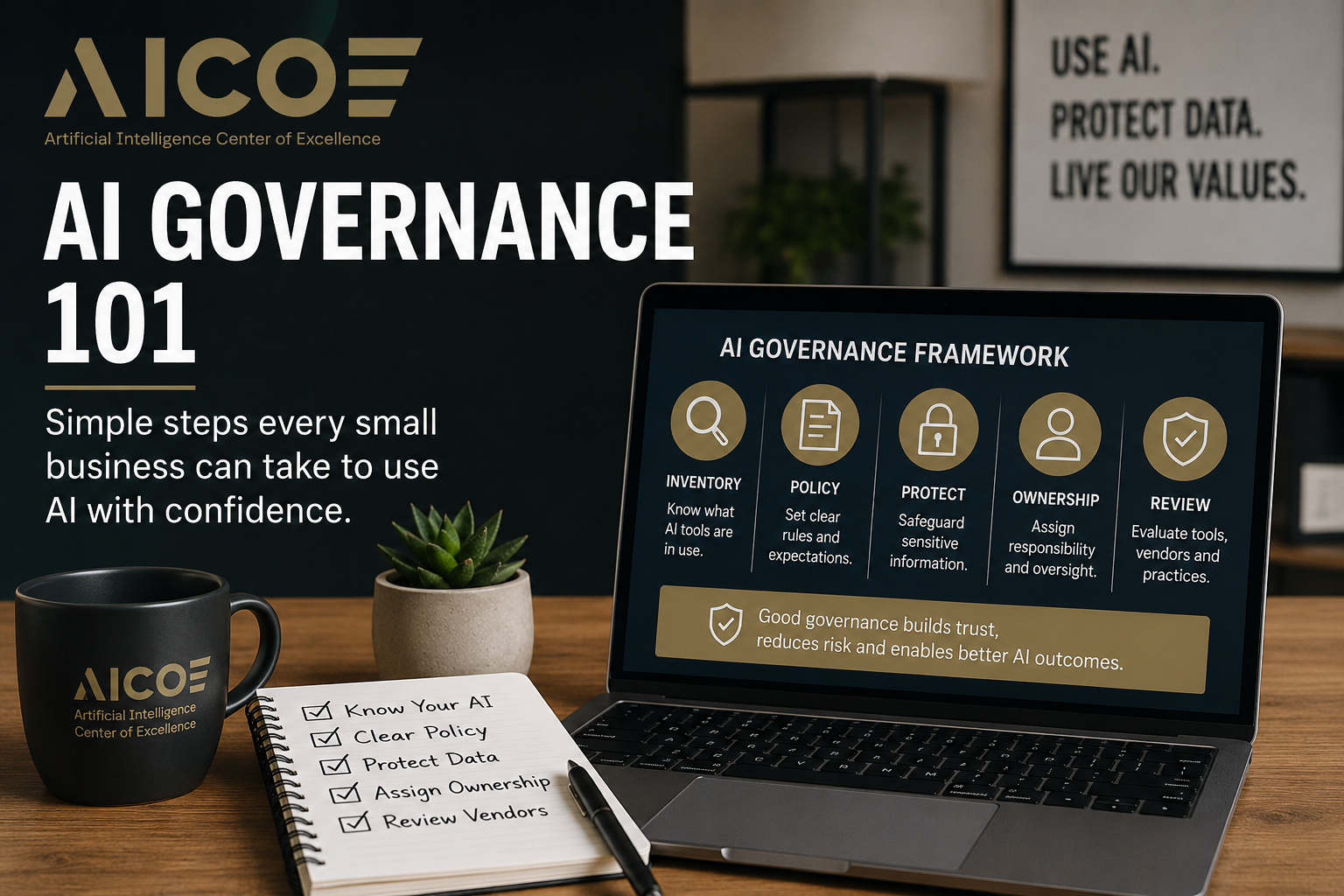
On August 2, major portions of the European Union's AI Act moved into enforcement. The law includes requirements around transparency, synthetic content and oversight of AI providers. While the details primarily affect organizations operating in Europe, the broader trend reaches much farther.
Large technology companies rarely build one version of their products for Europe and another for everyone else. Customer expectations, vendor requirements and procurement standards also tend to spread across markets. Many of the governance practices being formalized today will become familiar business expectations elsewhere.
Small and midsize businesses have an opportunity to establish good AI governance before customers, vendors or future regulations begin asking for it. Organizations that take the initiative today will spend less time reacting tomorrow.
The phrase "AI governance" often sounds like an enterprise initiative involving attorneys, auditors and compliance officers. Most businesses can establish an effective governance framework with a few operational decisions. The objective is straightforward: help employees use AI effectively while protecting the organization, its customers and its information.
The starting point is visibility.
Many leaders can name the AI tools they have approved. Far fewer can produce a complete list of the AI systems employees use every day. ChatGPT, Claude, Gemini, Copilot and dozens of specialized AI applications have become part of daily work. Every organization should know which tools are being used, what they are used for and who has access to them.
That inventory becomes the foundation for everything else.
Every business should also have a written AI policy. It does not need to be long. A single page can establish approved tools, identify what information should never be entered into public AI systems, define when human review is required and outline expectations for employees. As AI becomes more deeply integrated into operations, that policy can grow with the organization.
Understanding the models behind those tools is equally important.
AI systems differ in how they handle prompts, retain data, support enterprise privacy controls and use customer information for future model training. Businesses do not need to become AI researchers, but they should understand the capabilities and limitations of the systems they choose to use.
Sensitive information deserves the same level of protection inside AI tools as it does everywhere else. Customer records, financial data, employee information, trade secrets and confidential business documents should all be governed by clear policies that employees understand.
Ownership matters as well.
Someone should be responsible for maintaining the AI inventory, updating policies and evaluating new tools as they enter the organization. In a small business, that responsibility may belong to the owner, an operations leader or the person overseeing technology. Without ownership, governance quickly falls behind the pace of AI adoption.
Businesses should also begin asking more questions of their software vendors. AI capabilities are appearing inside products that companies have used for years. Understanding how those features work, what data they access and what controls are available is becoming part of normal vendor management.
None of these practices are particularly difficult. Together, they create the operating framework that allows organizations to adopt AI with greater confidence and fewer surprises.
Good governance rarely receives much attention because its value appears in what never happens. Sensitive information stays protected. Employees know which tools they can trust. New AI capabilities can be adopted more quickly because expectations are already in place. As AI becomes another standard business technology, those advantages compound over time.
A Practical Model for Setting Up AI Governance
Know your AI. Create and maintain an inventory of every AI application used across the organization, including employee-selected tools, vendor platforms and customer-facing services.
Document your expectations. Write a clear AI policy covering approved tools, confidential information, human review requirements and acceptable use. Review it regularly as new capabilities emerge.
Assign ownership. Designate someone to oversee AI governance, evaluate new tools, review vendors and keep policies current. Governance succeeds when responsibility is clear.
Build governance into operations. Include AI in procurement, employee onboarding, cybersecurity reviews and vendor management so governance becomes part of normal business practices rather than a separate initiative.
The organizations that realize the greatest value from AI will pair adoption with discipline. Governance provides the structure that allows businesses to move quickly, protect what matters and expand AI use with confidence.


%2FNegative.svg)
