
AI literacy is becoming civic infrastructure
The regions that invest in AI literacy today will be better positioned to compete, govern and adapt tomorrow.




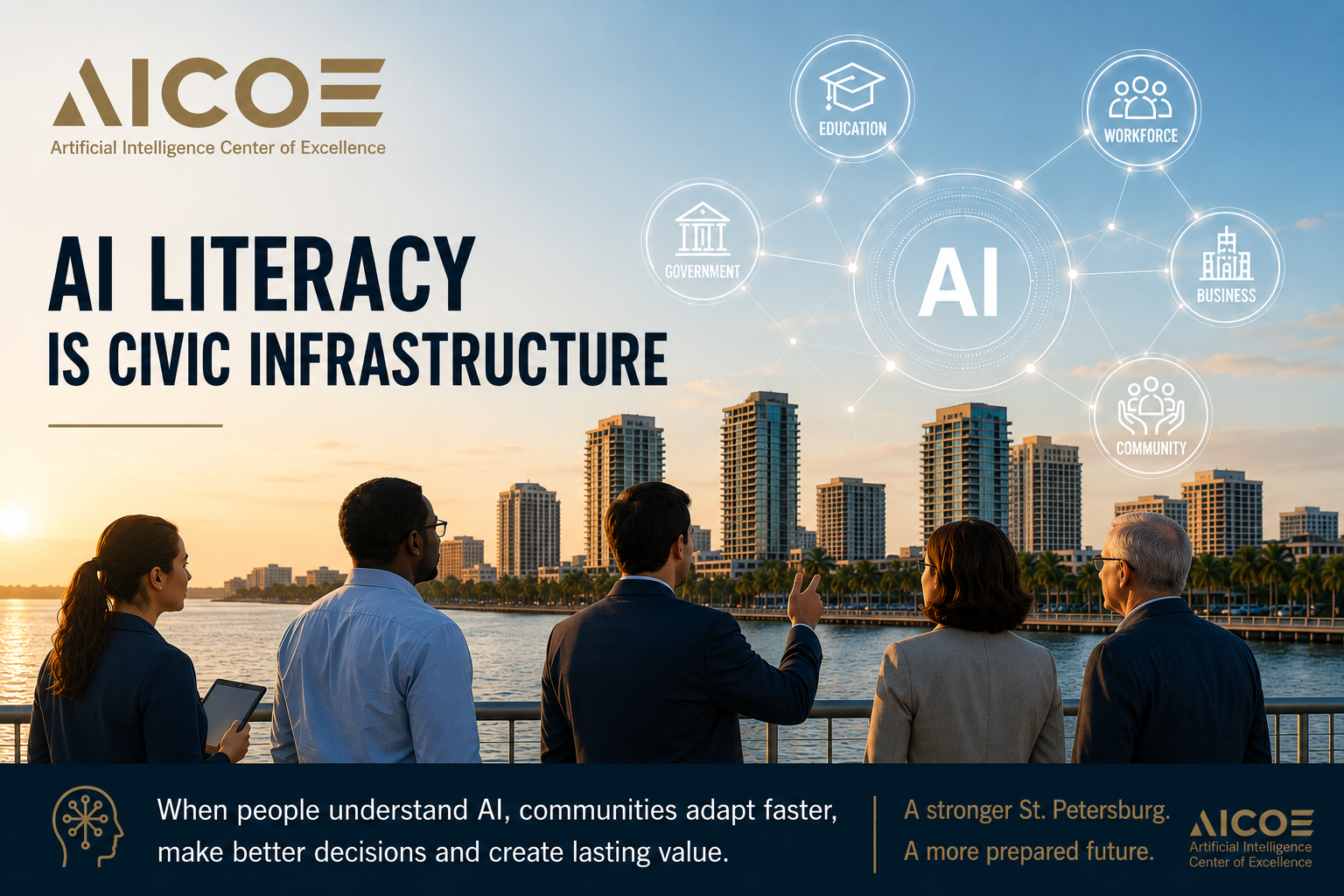
Artificial intelligence is often discussed as a technology investment. Governments debate regulation. Businesses compare software platforms. Schools experiment with new classroom policies.
Those conversations matter, but they overlook the resource that determines whether any AI investment succeeds.
Human capability.
Singapore recently announced an initiative to train 100,000 workers in AI skills, treating AI literacy as a national priority rather than an optional professional development program. That decision reflects a broader understanding that competitive advantage will increasingly come from people who know how to work with intelligent systems, not simply organizations that purchase them.
The same principle applies at the regional level.
St. Petersburg has spent decades building an innovation economy through entrepreneurship, higher education, healthcare, marine science and technology. Artificial intelligence now touches every one of those sectors.
That makes AI literacy a form of civic infrastructure.
Roads move people. Broadband moves information. AI literacy moves industry.
An accountant who understands how to evaluate AI-generated financial analysis becomes more productive. A city planner who can interpret AI-assisted modeling evaluates development proposals more effectively. A nonprofit executive who understands AI can stretch limited resources further while maintaining accountability. Teachers, healthcare providers, manufacturers and small business owners all benefit from the same underlying capability.
▌ A Practical Model for Civic AI Readiness
Awareness
Understand what AI can do, where it performs well and where human judgment remains essential.
Capability
Develop practical skills that improve everyday work instead of treating AI as a novelty.
Governance
Establish policies that encourage responsible adoption while protecting privacy, security and public trust.
Community
Create opportunities for businesses, educators, nonprofits and government to learn from one another rather than building isolated pockets of expertise.
The strongest regional AI ecosystems grow all four capabilities together.
One of the most important observations emerging from AI research is that job losses are not currently the primary indicator of change. Employers are already rewriting workflows, adjusting hiring expectations and changing the skills they value inside existing positions. Many roles still exist, but the work inside those roles is evolving.
That creates an opportunity.
Regions that prepare workers before disruption reaches full scale will experience far less friction than regions waiting for employment statistics to force action.
This is familiar territory. Communities that invested early in broadband attracted companies that depended on digital connectivity. Communities that invested in entrepreneurship built stronger startup ecosystems. AI literacy follows the same pattern.
The investment compounds over time.
Business leaders benefit from employees who understand how to redesign workflows instead of simply using new software. Local governments benefit from staff who can evaluate AI procurement, improve public services and ask informed policy questions. Schools benefit from graduates who arrive in the workforce ready to collaborate with intelligent systems rather than compete against them.
None of those outcomes happen automatically.
They require organized education, practical demonstrations, executive briefings, workforce development and ongoing collaboration across sectors.
And there needs to be a guiding force driving the effort. That is why the Artificial Intelligence Center of Excellence is being built in St. Petersburg.
We are building a regional capability that helps civic leaders, businesses, educators and nonprofits understand where AI creates value, where human judgment remains indispensable and how organizations can adapt with confidence.
The communities that lead during the next decade will not necessarily be those with the most AI companies or the largest technology budgets. They will be the communities that build the broadest base of AI-capable citizens, employees and institutions.
AI literacy deserves to be viewed alongside transportation, education and broadband as infrastructure that supports long-term economic growth.
The regions that plan for that shift will have a meaningful advantage as artificial intelligence becomes part of everyday work, public service and civic life.
AICOE Series: Civic Infrastructure for the AI Economy


%2FNegative.svg)
