
AI ROI Depends on Workflow Economics
The next generation of AI leadership will be defined by how intelligently organizations allocate computational labor across real operational workflows.




Enterprise software purchasing became highly standardized over the last two decades. Companies evaluated feature sets, negotiated licensing agreements, trained employees and expanded deployment across departments with the expectation that scale would gradually improve operating efficiency. The underlying infrastructure remained mostly invisible to leadership teams because software economics were relatively predictable once the platform was deployed.
AI changes the operating model because intelligence carries an active production cost every time work is performed. The economics are tied directly to usage patterns, workflow complexity and the amount of computational reasoning required to complete a task. That creates a very different executive conversation from the traditional software procurement process most organizations are accustomed to managing.
Many companies are still evaluating AI investments primarily through adoption metrics such as seats, users or platform access. Those measurements provide limited insight into whether the organization is creating meaningful economic leverage from intelligence systems. A thousand employees occasionally using an AI assistant may produce very little operational impact while a small engineering or operations team running high-frequency AI workflows continuously could generate substantial productivity gains alongside substantial computational expense.
The more useful framing is to evaluate AI at the workflow level rather than the application level.
A lightweight customer service assistant that summarizes support tickets consumes relatively modest intelligence resources. An autonomous workflow reviewing legal documents, processing insurance claims or generating software code across large repositories operates under a completely different cost structure because the system is performing sustained reasoning tasks at production scale.
The distinction matters because AI spending tends to accelerate after successful deployment rather than stabilize. As organizations discover workflows where intelligence creates measurable value, they naturally expand usage, increase context windows, add automation layers and introduce more concurrent activity across departments. Operational demand often grows faster than the forecasting models created during early deployment planning.
Most ROI models begin breaking down once organizations forecast user adoption instead of computational workload. Budgets built around software access rarely account for the intensity created by production-scale reasoning systems operating continuously across multiple workflows.
That forecasting gap often distorts spending in both directions, leaving organizations short on capacity in high-leverage workflows while simultaneously overspending on premium reasoning models for low-value tasks.
Strong AI operating discipline requires tighter alignment between intelligence cost and business value creation.
▌ A Practical Model for Evaluating AI ROI
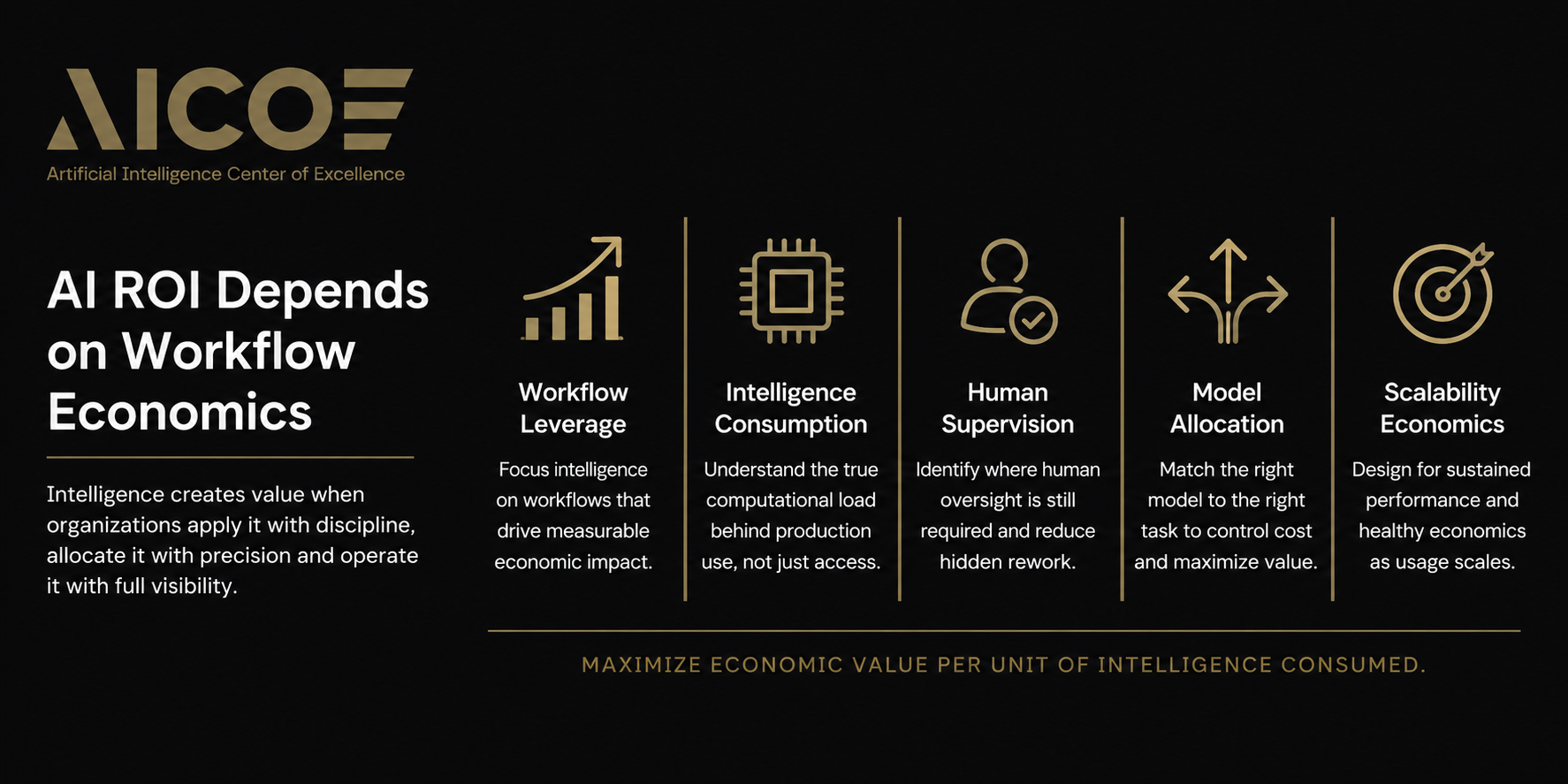
Workflow Leverage
Measure how much operational acceleration, margin improvement or decision-quality improvement the workflow produces once intelligence is introduced.
Intelligence Consumption
Estimate the actual reasoning load generated under production conditions, including concurrency, retries, context expansion and automation loops.
Human Supervision
Track where employees are still validating outputs, correcting errors or compensating for workflow instability behind the scenes.
Model Allocation
Align model sophistication to task value so higher-cost reasoning is reserved for workflows where advanced intelligence materially improves outcomes.
Scalability Economics
Evaluate whether the workflow maintains healthy economics as usage expands across teams, customers and operational environments.
The goal is to maximize economic value per unit of intelligence consumed across the organization.
This operational framing is becoming increasingly important because the cost dynamics of AI are evolving rapidly. Model efficiency continues improving through optimization techniques, smaller specialized models and more intelligent routing systems. At the same time, organizations are dramatically increasing demand as AI systems become capable of handling more sophisticated tasks inside real production environments.
Executive teams increasingly need visibility into where intelligence is being consumed, how workflows escalate computational demand and which systems are generating measurable operational leverage across the business.
Leadership teams now need operational awareness of how intelligence behaves inside workflows in the same way prior generations of executives needed visibility into labor allocation, supply chains or cloud infrastructure utilization. That does not require detailed expertise in GPUs, chip packaging or hyperscale data centers, but it does require understanding how workflow architecture, concurrency, latency and automation design influence operational economics.
The organizations building durable advantages in AI are approaching deployment with a much narrower and more disciplined focus than the public conversation often suggests. They are identifying specific workflows where intelligence creates measurable leverage, instrumenting those workflows carefully and continuously refining how computational resources are allocated across the system.
As intelligence systems move deeper into finance, operations, legal review and engineering workflows, organizations increasingly have to manage them with the same rigor applied to other forms of operational infrastructure.
Budget reviews increasingly need to account for how AI systems behave under sustained operational load, including how often workflows escalate to expensive reasoning models, where human supervision remains necessary and how concurrency affects serving costs during periods of peak usage.
Organizations that develop this operational discipline early will compound advantages over time because they will understand how to apply intelligence where it produces the highest measurable return across the business.
The executive challenge is increasingly tied to whether organizations can deploy intelligence economically across real workflows while maintaining operational visibility into the systems they are building.


%2FNegative.svg)
