
Before Florida says yes to data centers, communities need better math
Florida's new data center law gives local governments an opportunity to replace assumptions about AI infrastructure with a clear accounting of resources, economic value and community benefit.




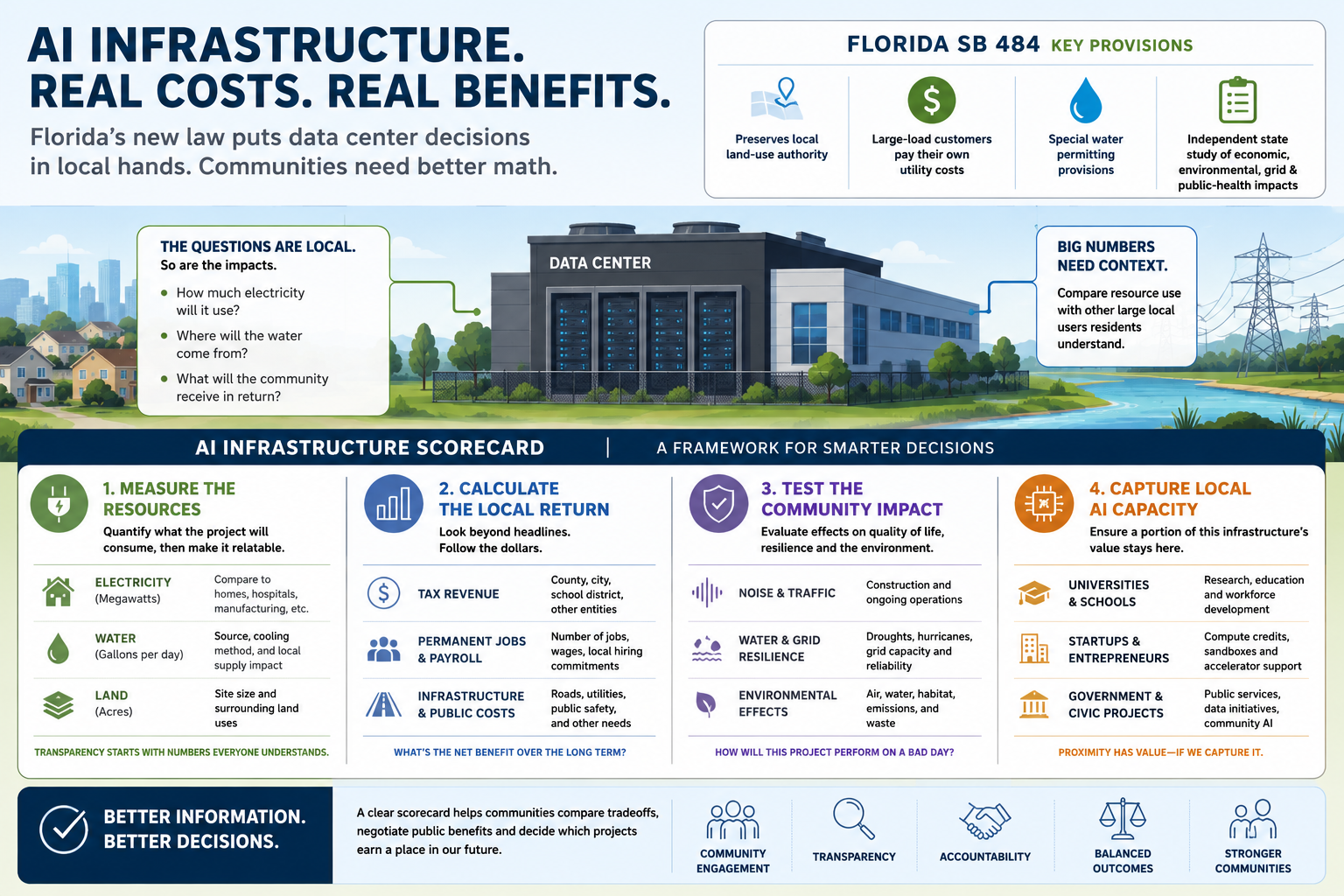
Florida's newest AI policy has a lot to do with electricity, water and land.
Senate Bill 484, which took effect July 1, establishes new requirements for large-load electricity customers such as hyperscale data centers. It addresses how their utility costs are allocated, creates water-permitting provisions, calls for an independent state study of their economic, environmental, grid and public-health impacts and preserves local authority over planning and land use.
That last piece puts counties and cities directly into the AI infrastructure business.
The timing is important. Communities around Florida are already wrestling with data center proposals and the resources they consume. Hernando County has moved to pause new data center development while it develops appropriate standards.
Those debates can become emotional quickly because the numbers are enormous. A proposed facility might require hundreds of megawatts of electricity or significant amounts of water. Presented alone, either number can sound alarming.
Communities need context.
If a proposed data center requires 200 megawatts, show residents what that means relative to other large electricity users. How many homes consume that amount? How does it compare with a hospital complex, manufacturing operation or other industrial facility?
Do the same with water. Identify the source, expected consumption, cooling technology and effect on local capacity. Compare it with other large permitted water users.
Then apply the same rigor to the benefits.
Data centers are unusual economic development projects. They can represent billions of dollars in investment without creating thousands of permanent jobs. That makes traditional job-creation arguments less useful.
Tax revenue may provide the strongest local economic case. If so, put a number on it. How much new revenue would the county, city and school system receive each year? What public costs would accompany the project? How much net revenue remains?
Local governments should also examine a benefit that receives far less attention: access to compute.
We tend to think of cloud computing as geographically detached from us. The physical infrastructure behind it exists somewhere. As AI workloads grow, proximity to computing infrastructure can affect latency, resilience, data movement and the ability to build certain local applications.
A community could go further and negotiate access.
Imagine a development agreement in which a portion of computing capacity, credits or related infrastructure is made available to local universities, startups, schools, government agencies and civic institutions. A data center serving global customers could then contribute directly to local AI capacity.
That benefit would have to be structured into the project. The presence of a data center does not automatically give its neighbors useful computing resources.
This is where Florida communities need to get ahead of the applications.
Pinellas County, for example, could develop an AI infrastructure evaluation framework before a hyperscale proposal arrives. Waiting until a developer has selected a site means landowners, residents, economic-development organizations, utilities and elected officials will already have positions tied to a particular project.
A framework created beforehand gives everyone the same starting point.
The process could resemble a public SWOT analysis. What resources will the project consume? What risks does it introduce? What tax revenue will it generate? What permanent employment will result? What infrastructure must be added? What happens during drought, hurricanes or grid emergencies? What benefits remain in the community?
Every major claim should come with a number and an understandable comparison.
"Uses a lot of water" is inadequate.
"Creates economic development" is inadequate too.
Florida now has an opportunity to build a more disciplined way of evaluating the physical infrastructure behind AI. A standardized AI Infrastructure Scorecard could give counties, developers and residents a common set of facts before public hearings begin.
A Practical Model for Evaluating AI Infrastructure
Measure the resources.
Require projected electricity, water and land use, then translate those figures into comparisons residents can understand.
Calculate the local return.
Quantify taxes, permanent jobs, public infrastructure costs and other measurable economic effects over time.
Test the community impact.
Evaluate noise, water availability, grid capacity, neighboring land uses, resilience and environmental effects under normal and stressed conditions.
Capture local AI capacity.
Explore agreements that provide compute access, credits or related resources to local universities, schools, startups, government and civic institutions.
Florida communities will face legitimate tradeoffs as AI infrastructure expands. Better information will allow residents and elected officials to see those tradeoffs clearly and decide which projects earn a place in their communities.


%2FNegative.svg)
