
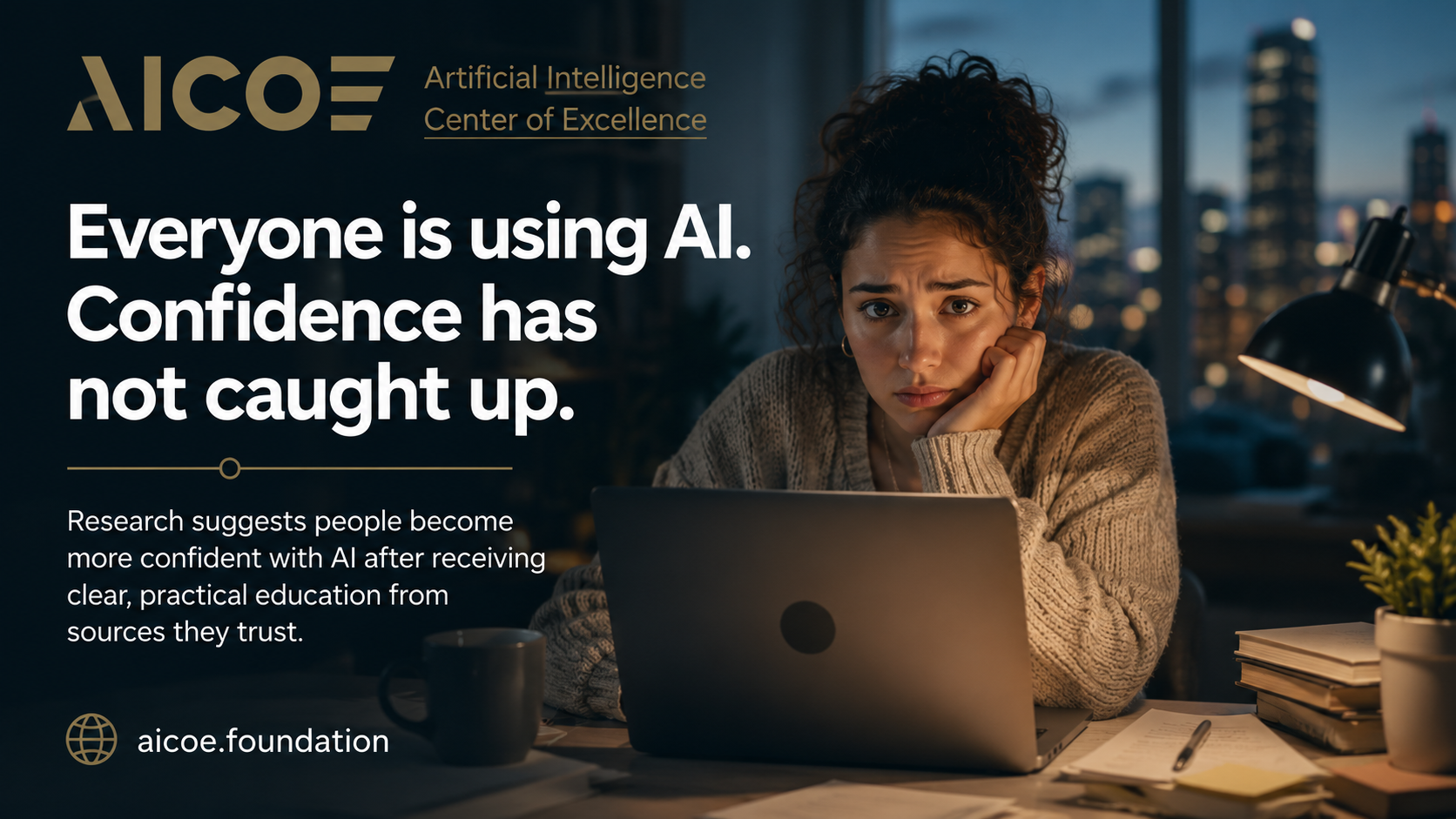
Everyone is using AI. Confidence has not caught up.
Research suggests people become more confident with AI after receiving clear, practical education from sources they trust.




Artificial intelligence has already become part of daily life. People use it to write emails, summarize documents, answer questions, plan trips and solve problems at work. Many do so without formal training or a clear understanding of how these systems produce answers.
Research from Verasight found that nearly two-thirds of Americans used AI during the past month. Many participants still expressed uncertainty about when to rely on AI, when to verify its answers and how these systems should fit into important decisions.
Most people have already experienced both sides of the technology. AI can save an hour of work with a thoughtful answer, and it can confidently produce inaccurate information a few minutes later. Those mixed experiences shape public confidence more than technical discussions about model performance.
Practical education helps people understand why those different outcomes occur. Once users recognize the strengths and limitations of AI, they become more consistent in deciding when to rely on it and when additional verification is appropriate.
For many years, digital literacy meant teaching people how to use computers, search the internet and recognize online scams. AI literacy expands that foundation. People need practical skills that help them ask better questions, recognize when human judgment is essential and understand where AI creates value.
Research conducted with Trusting News found that a single piece of plain-language educational content increased trust among nearly half of participants. The finding illustrates how quickly confidence can improve when people receive practical guidance instead of technical explanations.
National conversations about AI often focus on billion-dollar investments, advanced research and competition between technology companies. Most people, however, will develop their opinions through local experiences. They will trust the employer who explains how AI fits into their work. They will trust the school that teaches responsible use. They will trust the library, community organization or civic institution that helps them understand what these systems can and cannot do.
Local institutions are well positioned to close that knowledge gap. Employers, schools, libraries and civic organizations already teach digital skills, financial literacy and workforce development. AI literacy fits naturally alongside those efforts because people are far more likely to trust information delivered by organizations they already know.
▌A Practical Model for Building AI Confidence
Understand
Learn what AI does and how it produces responses.
Practice
Use AI on everyday tasks where mistakes carry low consequences.
Verify
Check important facts, calculations and decisions before acting.
Expand
Apply AI to larger workflows as confidence and experience grow.
Organizations that teach these habits will build a workforce that uses AI more effectively and with greater confidence.
This is one reason the Artificial Intelligence Center of Excellence is investing in education alongside technology. Every organization, municipality and workforce will adopt AI at its own pace. Shared understanding gives people the confidence to evaluate new tools, ask better questions and make stronger decisions as those tools become part of everyday work.
The region has an opportunity to build that capability before uncertainty becomes a barrier to adoption. Communities that make AI education accessible today will develop a workforce that approaches these systems with practical judgment, adapts more quickly to new technologies and helps others do the same.
The next phase of AI adoption will depend on more than access to increasingly capable models. It will depend on whether people have the knowledge and confidence to use them well.


%2FNegative.svg)
