
Florida’s civic AI opportunity starts with hurricane coordination
St. Petersburg could test an AI-powered information network that moves verified emergency information through government, media and community organizations without the delays of manual distribution.




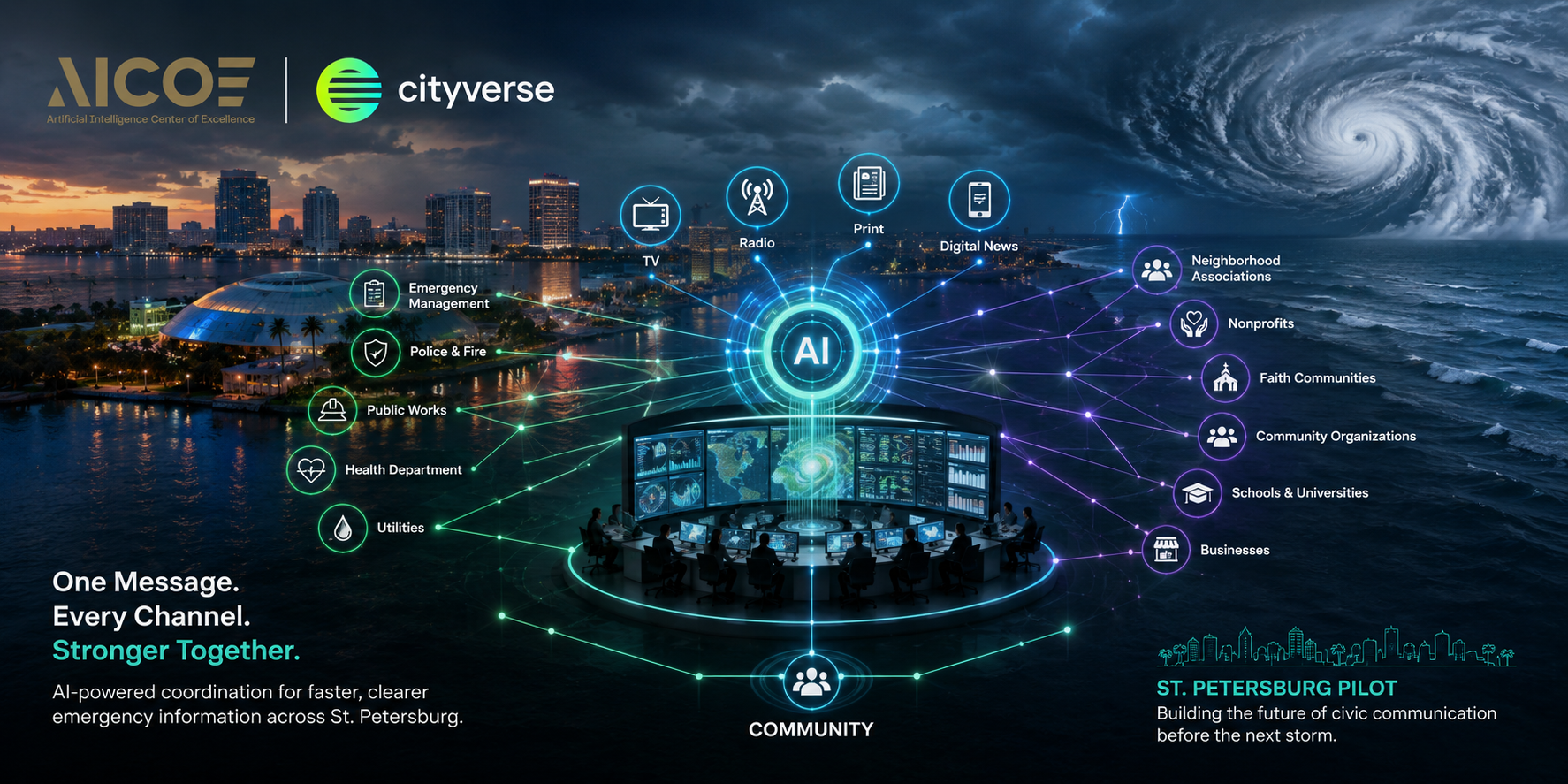
Florida already has sophisticated systems for managing hurricanes. The Florida Division of Emergency Management operates an enterprise platform connecting functions including mutual aid, grants, procurement, resources and finance. In Tampa Bay, the Tampa Bay Regional Planning Council coordinates emergency preparedness across six counties and 21 municipalities and has developed Project Phoenix to simulate the regional consequences of a major hurricane.
There is another piece of hurricane infrastructure worth developing: how information moves from the command center to the people who need it.
Emergency information travels through a large network. A city issues an evacuation update. Emergency management distributes guidance. Television stations, newspapers and digital news organizations report it. Neighborhood associations send emails. Nonprofits contact clients. Churches communicate with congregations. Hospitals and health organizations reach vulnerable populations. Businesses communicate with employees and customers.
Each organization provides another path into the community. Each handoff can introduce time, interpretation and additional manual work.
AI gives us the ability to design that distribution network differently.
Imagine an emergency command center publishing a verified piece of information into a governed AI system. The system understands which organizations need the information, the populations they serve and the communication channels available to them.
An evacuation change could immediately generate information appropriate for a television newsroom, a neighborhood association email, a nonprofit text alert, a church communication network and a municipal website. Organizations could receive the same verified source information in formats designed for their particular audiences.
Humans would establish the rules, approve the sources and determine which information AI is authorized to distribute. Once verified information enters the system, distribution could happen almost immediately.
This is where the <a href="https://sciencecenter.ai/aicoe/civic-stack">AICOE Civic Stack</a> becomes useful as an operating model.
A hurricane crosses every layer of the stack. Government produces authoritative information and coordinates response. Civic infrastructure reaches neighborhoods and populations through trusted organizations. Media provides broad public distribution and independent reporting. Businesses communicate with employees and customers. Education and health institutions reach their own communities.
Today, those layers communicate through thousands of individual relationships. AI could provide connective infrastructure between them.
The network could work in both directions.
Neighborhood associations, nonprofits, churches and other organizations often see conditions that centralized agencies cannot immediately see. They may know that a senior housing complex has lost power, a neighborhood is flooding or residents are confused about an evacuation instruction. Structured AI systems could collect those signals, organize them and surface patterns to emergency managers without requiring command-center staff to manually monitor hundreds of communication channels.
That creates a potentially powerful loop: verified information moves outward quickly while structured community intelligence moves back toward decision makers.
St. Petersburg would be a strong place to pilot it.
The city has hurricane exposure, an active civic ecosystem, established regional emergency-management relationships and a dense network of local media and community organizations. Cityverse could provide part of the distribution infrastructure, connecting verified information with participating publishers and community channels. AICOE could help develop the governance, AI architecture and Civic Stack framework around the network.
The first version does not need to coordinate every organization or every type of emergency information. A pilot could select a narrow category such as evacuation information and connect a manageable group of government, media and civic partners.
The hurricane provides the stress test. Once the network exists, its usefulness extends into normal civic operations. Road closures, boil-water notices, public-health information, major events and other time-sensitive information face many of the same distribution problems.
A Practical Model for an AI Emergency Information Network
Establish the source of truth. Define which emergency agencies and officials can introduce verified information into the network and what information AI is authorized to distribute.
Map the Civic Stack. Identify participating government agencies, media organizations, neighborhood associations, nonprofits, churches, health institutions and other community channels along with the populations they reach.
Build governed distribution. Allow AI to convert verified information into channel-appropriate formats while preserving the meaning, source and required language of the original message.
Create a return channel. Give participating organizations a structured way to submit local conditions and community needs so AI can organize those signals for emergency managers.
Florida already knows how to build emergency command structures. AI gives us an opportunity to connect those structures much more directly to the civic networks that ultimately carry information into the community. St. Petersburg is small enough to build that network deliberately and large enough to prove whether it works.


%2FNegative.svg)
