
The Reality Curve You Should Operate On
AI capability is advancing rapidly, but implementation remains the real bottleneck for most organizations.




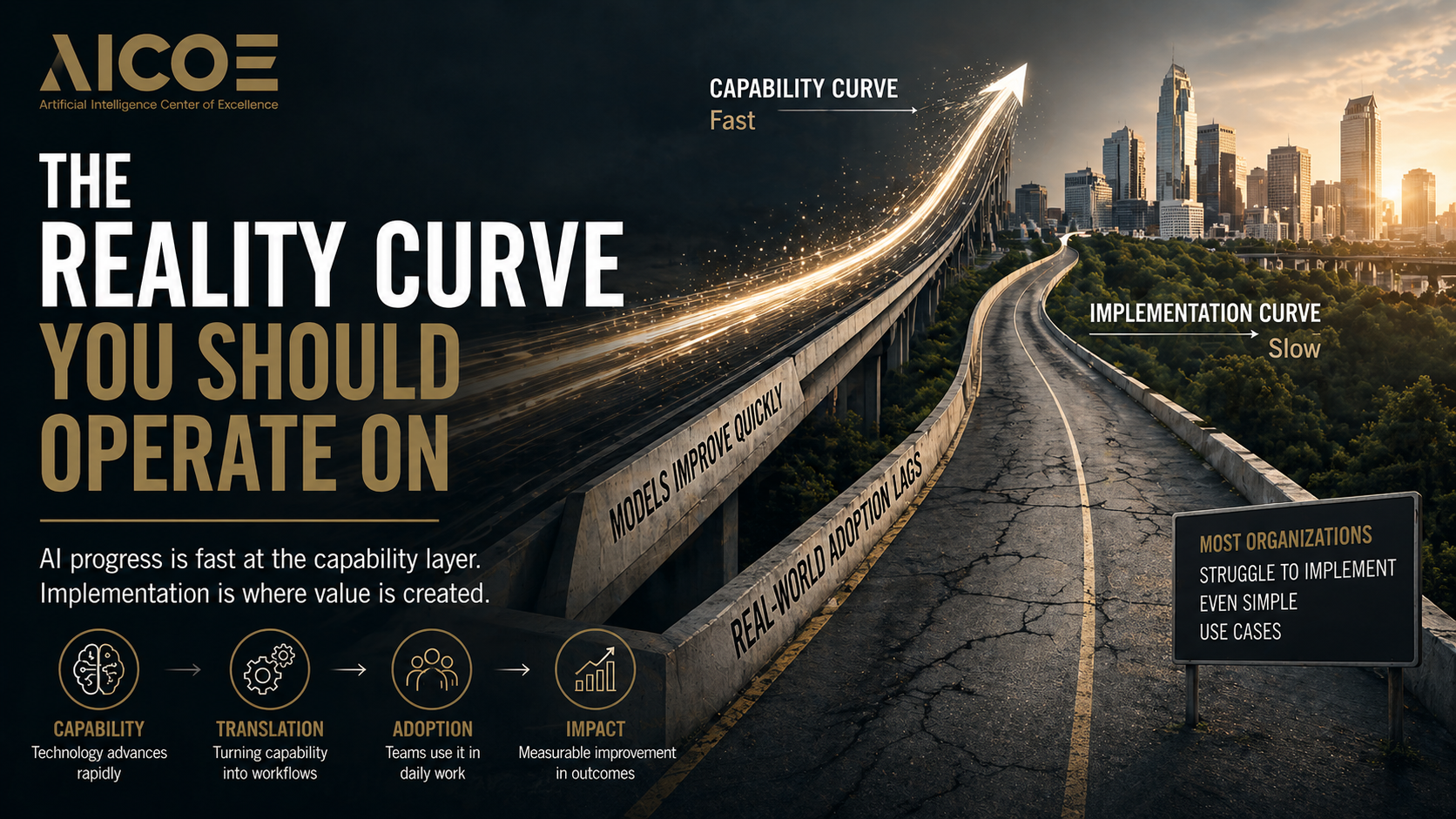
There is a growing disconnect between how artificial intelligence is discussed and how it is actually showing up inside organizations.
At the capability layer, progress is moving quickly. New models are released constantly. Performance improves across reasoning, generation and multimodal tasks. The pace is visible and easy to track, which makes it feel like entire industries are changing overnight.
Implementation tells a different story.
Most organizations are not operating anywhere near the frontier of what these systems can do. Many are still working through basic integration, internal alignment and narrowly defined use cases that deliver consistent value.
Both realities exist at the same time, and understanding the gap between them is becoming an important leadership skill.
AI progress is fast at the capability layer and slow at the implementation layer. Models improve quickly, but organizations still have to translate those capabilities into workflows, operating procedures and measurable outcomes.
That translation is where most of the difficulty sits.
AI systems do not operate in isolation. They have to connect to workflows, data sources, decision processes and teams that may not yet trust or fully understand them. Even relatively simple use cases often require coordination across departments, clarity around outcomes and adjustments to how work gets done.
As a result, many organizations fall into a familiar pattern. They recognize the potential of AI, experiment with tools and then stall when it comes time to operationalize them.
Most implementation friction comes from the way organizations operate, not from limitations in the technology itself.
▌ A Practical Model for the AI Reality Curve
Capability
What the technology can do today and how quickly it is improving
Translation
The work required to turn capability into a usable workflow
Adoption
The degree to which teams actually use it in daily operations
Impact
The measurable improvement created once adoption becomes consistent
Organizations that move effectively through these stages create compounding implementation advantage over time.
Most public attention stays fixed on the first curve because capability gains are dramatic and easy to see. The second curve is slower and less visible, but it is where actual value is created.
Leaders who assume both curves move at the same speed will either overestimate what their organization can accomplish in the short term or underestimate what becomes possible over time.
Operating on the right reality curve means understanding that capability will continue advancing rapidly while implementation requires deliberate effort, organizational alignment and sustained focus.
For civic and business leaders, this changes how AI strategy should be approached.
The goal is not to chase every new capability as it emerges. That diffuses effort and creates noise inside organizations already struggling with change management and operational complexity.
The goal is to build the internal ability to translate useful capabilities into repeatable workflows that people trust and consistently use.
Organizations that do this well typically start with narrow, clearly defined use cases. They solve specific problems, measure results and expand from a position of confidence. Over time, successful implementation compounds because each adoption cycle creates more familiarity and organizational readiness for the next.
At a regional level, this gap between capability and implementation has major implications.
Regions focused only on awareness of AI will struggle to convert that awareness into economic advantage. Competitive regions will be the ones that build implementation capacity across businesses, institutions and the workforce itself.
This is where we are concentrating our effort in Tampa Bay.
At the Artificial Intelligence Center of Excellence, the focus is not simply exposure to AI tools. The focus is helping organizations and individuals close the gap between what AI can do and what they are operationally prepared to implement.
That includes identifying practical use cases, integrating AI into existing workflows and developing the judgment required to sustain adoption over time.
The objective is steady, applied progress that improves real outcomes across the region.
As AI capability continues to accelerate, the gap between technological possibility and organizational implementation may widen before it narrows.
The organizations and regions that benefit most will not necessarily be the first to experiment. They will be the ones that consistently translate capability into practice with clarity, discipline and operational focus.


%2FNegative.svg)
