
What a Driverless Tractor Says About Your Fixed Costs
The operators winning with AI are cutting idle costs before they buy the tool, not after.




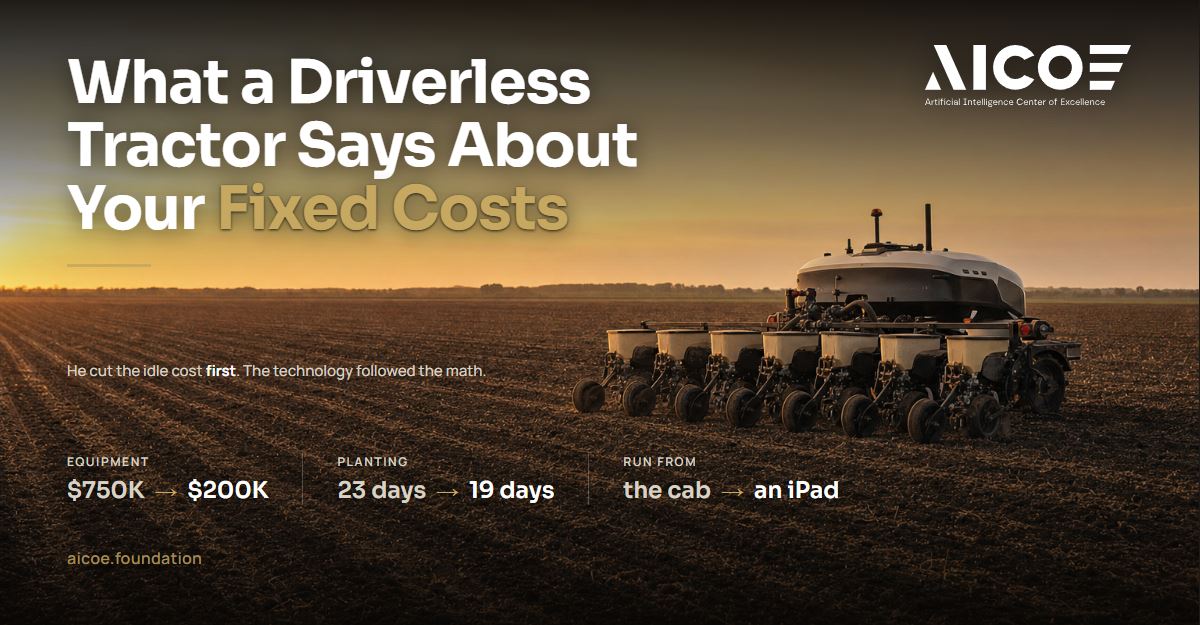
Quint Pottinger farms land his family has worked for eight generations near New Haven, Kentucky. This spring he planted his full corn and soybean crop without climbing into the cab. He sold two large tractors and two 40-foot planters, close to $750,000 in equipment, and bought a 130-horsepower tractor, an eight-row planter and a Sabanto autonomy kit for about $200,000. He ran the planting from an iPad.
The numbers behind that decision are worth sitting with. His previous setup took 23 days and two 16-row planters to seed his fields. This season he projected finishing in 19 days with one small tractor operating on its own, guided by Precision Planting software and a Starlink connection. He is the first farmer in Kentucky to plant an entire crop this way and one of fewer than 50 nationwide.
Notice the order of his moves. He cut the fixed cost first. The autonomy kit was the piece that let him operate with less equipment, but the money came from selling iron he no longer needed to own. The technology followed the math.
I spend my days at the Artificial Intelligence Center of Excellence working with civic institutions, businesses, schools and nonprofits on where AI actually fits. The pattern I see most often runs the opposite direction from Pottinger's. An organization starts with the tool. It buys a platform, names it a priority and then goes looking for a problem the platform can solve. The spending grows and the return stays hard to locate.
There is data behind that pattern. In PwC's most recent global survey of chief executives, more than half of the companies investing in AI reported no meaningful value from it. The chairman's explanation was not technical. Companies moved to sophisticated tools before they defined a use case, cleaned their data or simplified the workflow the tool was meant to improve.
Pottinger did the unglamorous work first. He found the cost that was quietly draining him, the interest on equipment sitting idle most of the year. Then he removed it. For a county office in Pinellas, a manufacturer in Tampa or a nonprofit here in St. Petersburg, the equivalent is not a software license. It is an honest look at which fixed costs, which manual bottlenecks and which idle capacity a specific tool would actually change.
His move also reframes what readiness means. Pottinger did not need a data science team. He needed to understand his own operation well enough to know what to cut. The capability that carried the decision was operational judgment, and that is the capability most organizations underbuild while they shop for tools.
A Practical Model for Adopting AI Like an Operator
Find the idle cost first. Before evaluating any tool, name the fixed expense, manual bottleneck or unused capacity that is costing you now. If you cannot name it, you are not ready to buy.
Match the tool to that cost. Adopt the technology that changes the specific number you found. Let the problem select the tool, not the reverse.
Keep the footprint small. Pottinger traded a $750,000 setup for a $200,000 one. The goal is less to maintain and less to service, not more to manage.
Build the judgment, not just the capability. The person who understands the operation is worth more than the platform. Invest in that understanding before the subscription.
Fewer than 50 farms have done what Pottinger did. That number will climb. The operators who move well will be the ones who found their idle costs before they went shopping. The institutions across Tampa Bay weighing AI this year face the same test.


%2FNegative.svg)
