
What local leaders should understand about implementing AI
A new global survey suggests many citizens now see slow AI adoption as part of the reason government services fall short.




Boston Consulting Group's latest global survey found that citizens who are least satisfied with public services are also the most likely to believe their governments are moving too slowly on AI. At the same time, nearly two-thirds still want human oversight built into AI-supported services.
That finding illustrates the conflicting emotions that a technology shift as sweeping as artificial intelligence can inspire in people. To honor this conflict, leaders can’t treat AI adoption as a singular path. Governments should think about implementation across two spectrums: how comfortable citizens are with AI in general and how much risk they perceive in a specific AI application.
Every community contains both AI skeptics and AI adopters. Some residents approach every AI discussion with caution. Others already expect the government to use AI anywhere it can improve service without sacrificing accountability. A strategy built entirely around the first group will frustrate the second. A strategy built entirely around the second will leave the first behind. Good implementation recognizes both audiences.
The second spectrum is even more important. Every government AI application carries a different level of perceived risk.
Checking whether a permit application is complete feels very different than approving or denying that permit. Routing a service request feels different than determining benefit eligibility. Summarizing public comments feels different than making an enforcement decision.
Government should deliberately sequence AI implementation, and the public messaging of the changes, from the lowest perceived risk to the highest.
Permit review provides a useful example.
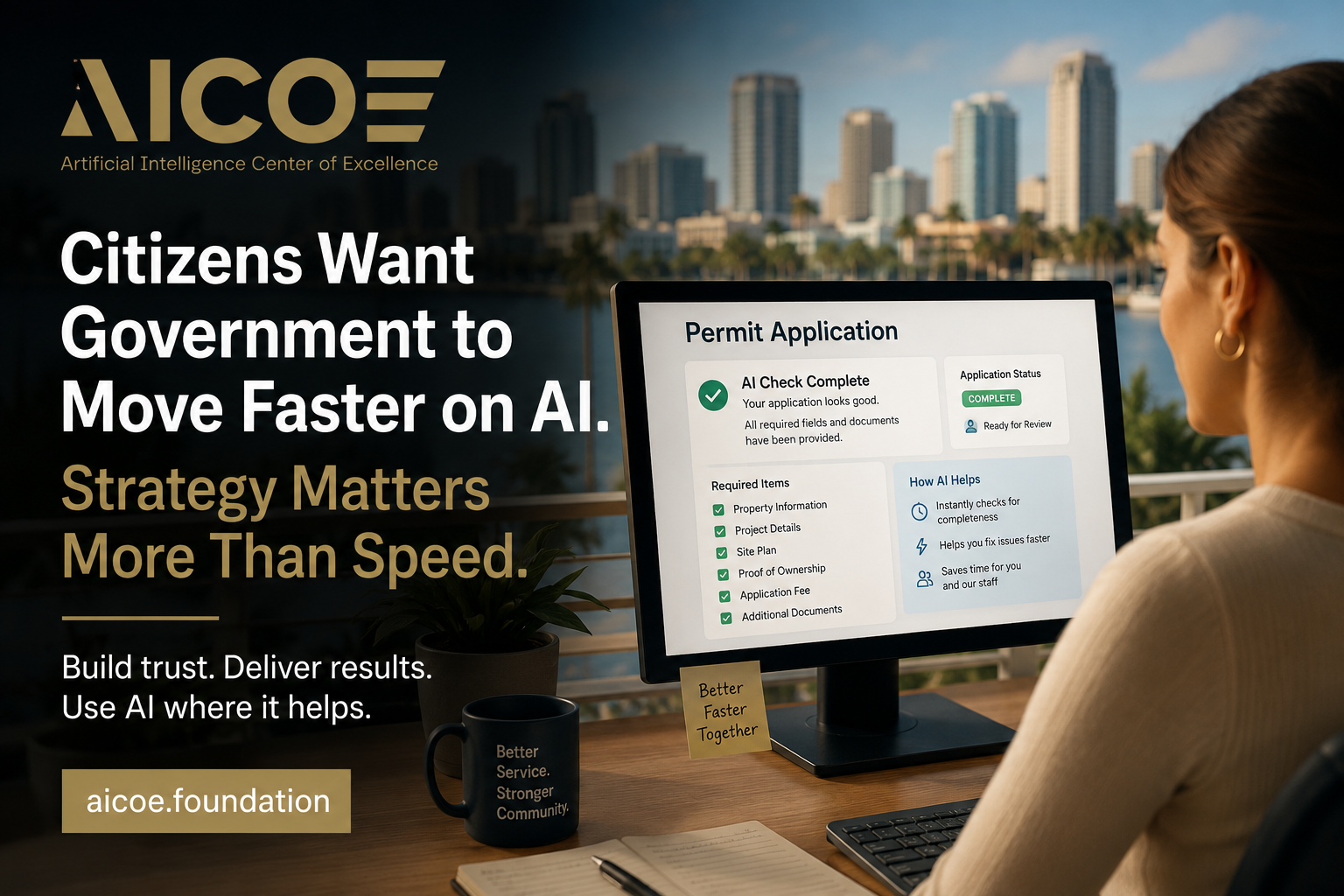
Imagine a resident submits a permit application. Before a human ever sees it, AI checks whether every required field has been completed and every required document has been uploaded.
If AI notices a missing attachment, it immediately tells the applicant what needs to be corrected. The resident fixes the issue that day instead of discovering it a week later when a staff member rejects the application.
Consider the consequences of a technology fail: AI doesn’t catch the missing attachment.
What changed?
Very little.
The permit still moves into the existing review process where a human reviewer identifies the omission exactly as they do today.
The perceived risk is negligible because there’s only upside. The permit completeness check cannot realistically create a worse outcome than the current process because the existing human review remains in place. The upside is faster service. The downside is the existing workflow. That is a comfortable use case for all.
Considering AI tasks through this lens is important because it creates a simple test for choosing excellent first AI projects.
Can AI make this process worse than it is today?
If the answer is no, that’s an ideal opportunity to build trust in AI.
There is another benefit that’s worth noting.
When AI catches the missing attachment, the resident walks away with a positive artificial intelligence experience. They remember that the technology saved them the week it would have taken the human to check the document. The interaction is helpful and delievers immediate value.
That experience becomes the foundation for the next one.
Later, when that same resident encounters an AI assistant that answers permitting questions or helps complete an application, they enter the conversation with a foundation of success instead of uncertainty. Trust grows through useful interactions.
Governments should actively engineer and share these successes. Every low-risk implementation that improves service becomes a public demonstration of responsible AI. Those examples help citizens understand where AI adds value, where people remain accountable and why the technology was introduced in the first place.
Government leaders should also resist the temptation to communicate only to residents who fear AI. A growing share of citizens already expect government to use modern tools to deliver better services. Speaking about AI with excessive hesitation can signal something very different from caution. It can suggest leadership lacks the understanding of AI to such a degree that fear trumps optimal use of the transformative technology.
Responsible AI adoption does not require one message or one implementation plan. It requires understanding the audience, understanding the perceived risk of each application and building confidence one successful use case at a time.
A Practical Model for Sequencing Government AI
Map your audiences. Recognize that communities include both AI skeptics and AI adopters. Communication should address both groups rather than assuming one perspective represents everyone.
Start where the downside is limited. Prioritize AI applications where human review already exists and failure simply returns the process to today's workflow.
Publicize practical wins. Share examples of faster permits, shorter wait times and better service. Positive experiences become the foundation for future adoption.
Expand as confidence grows. Use successful low-risk implementations to introduce more capable citizen-facing AI services while maintaining clear human accountability.
The conversation about government AI often focuses on policy before implementation. Communities also need a practical roadmap. Leaders who organize adoption around citizen readiness and perceived risk can improve public services today while building the trust needed for what comes next.


%2FNegative.svg)
