
When AI literacy becomes a graduation requirement, leadership requirements change too
Boston Public Schools will require AI literacy for graduation beginning this fall. The decision raises a practical question for every organization led by people who entered the workforce before AI education existed.




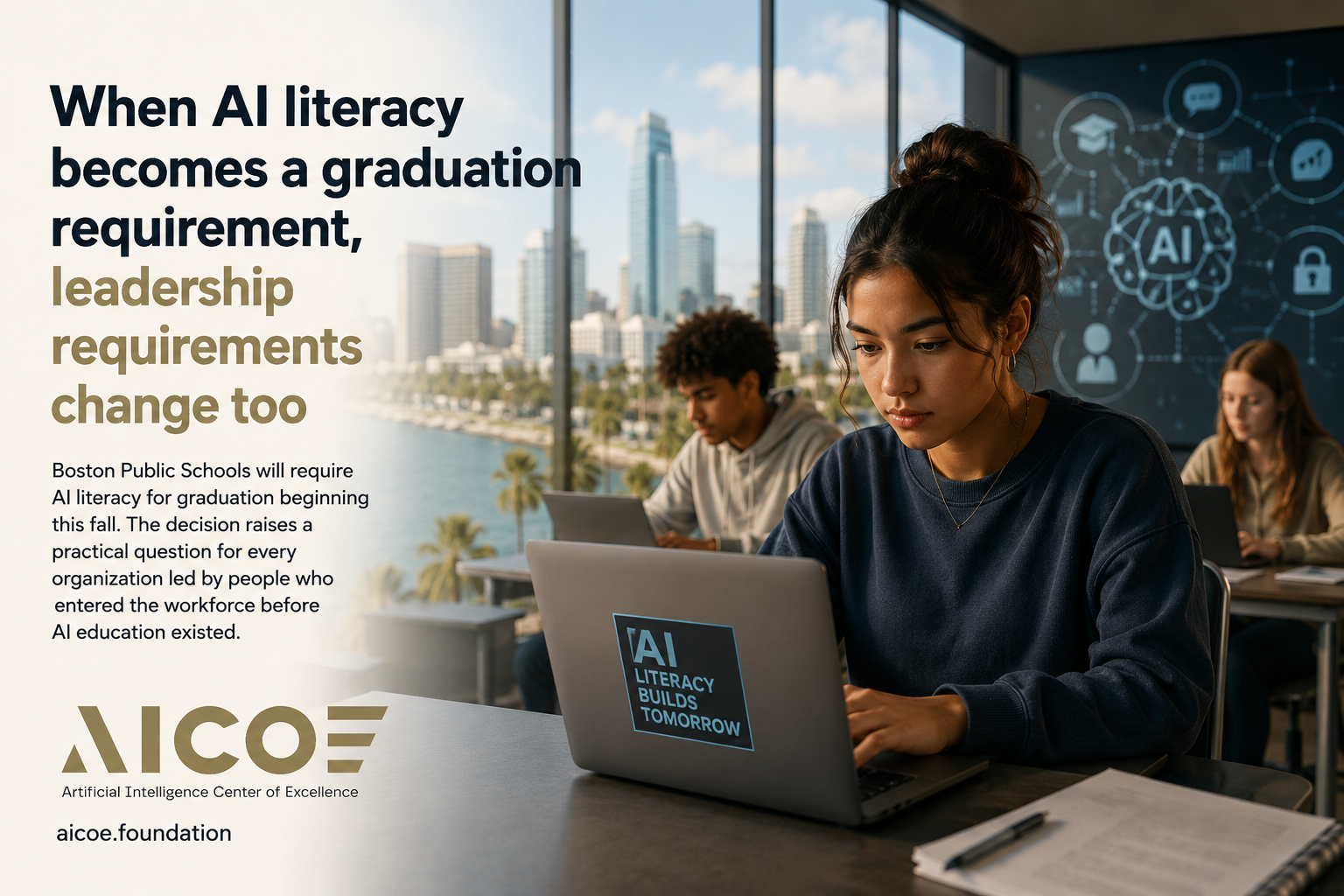
Boston Public Schools recently announced that AI literacy will become a graduation requirement beginning this September, making it the first major-city school district in the country to take that step. The initiative is backed by a $1 million seed grant and will reach every high school student in the district.
That decision deserves attention well beyond Boston. Communities like St. Petersburg are already investing in AI through businesses, government and education. Boston's announcement adds another dimension by defining AI literacy as a skill every graduate should possess before entering the workforce.
Graduation requirements represent a community's judgment about the knowledge every young adult should possess before entering the workforce. Reading, mathematics, science and civics all earned that status because they prepare people to participate effectively in society. Boston has now placed AI literacy into that category.
Other school districts will now decide whether to adopt similar graduation requirements. The pace will vary, but Boston has established a precedent that educators across the country will follow. St. Petersburg has an opportunity to get ahead of other communities.
Students graduating over the next few years may enter the workforce with a stronger foundation in artificial intelligence than many supervisors, executives and elected officials. That creates an unusual moment in the evolution of work.
For decades, organizations assumed experience would naturally include greater technical understanding. New employees learned from veteran managers because those managers had accumulated knowledge over years of practice. Generative AI interrupted that pattern. Many experienced leaders built successful careers before generative AI existed. Their expertise remains valuable, but it was developed before AI became part of everyday work.
Leadership still depends on judgment, experience and accountability. Leadership teams across St. Petersburg also need a working understanding of AI so they can make informed decisions about technology that increasingly shapes operations, customer service and public expectations.
AI literacy is often misunderstood. It is not limited to writing prompts or experimenting with the latest tools. Leaders need enough knowledge to recognize where AI creates value, where it introduces risk and what questions should be asked before adopting it. Those are leadership responsibilities, not technical specialties.
▌ A Practical Model for Leadership AI Literacy
Awareness
Understand what today's AI systems do well, where they struggle and the limits that still exist.
Application
Identify specific work inside your organization that can be improved through AI rather than adopting technology for its own sake.
Governance
Establish clear expectations for security, privacy, transparency and responsible use before AI becomes embedded in daily operations.
Culture
Create an environment where employees can learn, experiment and share practical successes without fear of making mistakes.
For most of modern history, schools adapted to the needs of employers. AI may create periods where schools begin producing graduates with capabilities that many workplaces have not yet fully embraced. Knowledge begins flowing in both directions. New employees bring current AI skills while experienced leaders contribute judgment, institutional knowledge and perspective. Organizations that encourage both forms of expertise will adapt more effectively.
St. Petersburg's employers span startups, hospitals, financial firms, local government, nonprofits and small businesses. Every one of them will soon begin hiring graduates who have received formal AI instruction. Those organizations will benefit when managers and executives have developed the same foundational understanding.
Boston's announcement is ultimately less about education than preparedness. A graduation requirement signals what one community believes every young adult should know before beginning the next chapter of life. Communities that invest in AI literacy for students while also helping today's workforce and civic leaders develop the same foundation will be better positioned to compete, innovate and serve their residents.
Every community will eventually face the same question: if AI literacy belongs in a high school diploma, where does it belong inside the businesses, nonprofits and public agencies that employ those graduates in St. Petersburg?


%2FNegative.svg)
