


CONTENT

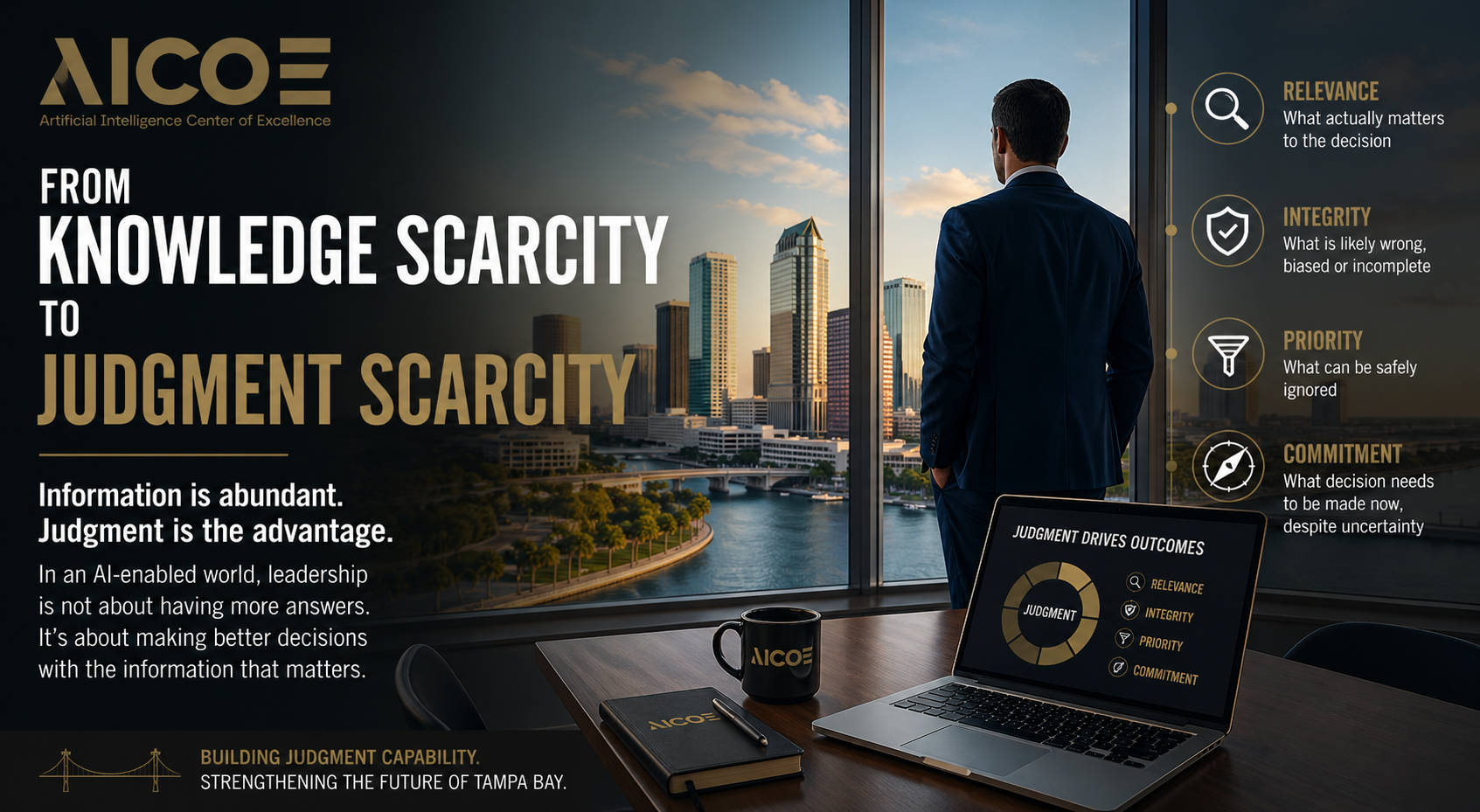

From Knowledge Scarcity to Judgment Scarcity
From Knowledge Scarcity to Judgment Scarcity
For most of modern history, access to knowledge defined advantage. Institutions, companies and individuals built their edge by acquiring information that others did not have, and expertise was often a function of accumulation over time.
That model is now under pressure. Information is immediate, searchable and increasingly generated on demand. What once required years of study or privileged access can now be surfaced in seconds.
This shift is already changing how work gets done and how decisions are made.
As information becomes abundant, the constraint shifts. Access is no longer the limiting factor. Interpretation is.
The advantage now sits with those who can determine what matters, what is flawed and what can be ignored.
Leaders are operating in an environment where inputs compound daily. Reports, dashboards, analysis and AI-generated outputs create more volume than any individual can fully process.
The expectation is no longer to accumulate answers. It is to navigate competing inputs, challenge conclusions and move decisively with incomplete information.
A simple way to frame it:
A Practical Model for Judgment in an AI Environment
Relevance — What actually matters to the decision at hand
Integrity — What is likely wrong, biased or incomplete
Priority — What can be safely ignored
Commitment — What decision needs to be made now, despite uncertainty
Leaders who apply this consistently will move faster and with more clarity than those who continue to rely on volume of information as a proxy for confidence.
In this context, artificial intelligence is a system that accelerates the production and organization of knowledge.
It can summarize, model, predict and generate outputs at scale. It can surface patterns and offer recommendations quickly. What it does not do is carry responsibility for outcomes.
That responsibility remains with the human decision-maker.
AI increases the supply of knowledge while raising the standard for judgment required to use it well.
For civic and business leaders, this changes the nature of effective leadership in a practical way.
Organizations that rely on more data to drive better decisions will often find themselves slowing down. The bottleneck is no longer access to information. It is the ability to interpret it and act.
Organizations that develop strong judgment will move faster and with more consistency, even as complexity increases.
At a regional level, this shift affects workforce readiness and economic competitiveness. A workforce trained to gather and repeat information will struggle to differentiate. A workforce trained to evaluate, prioritize and decide will operate at a higher level.
This is the capability we are building in this region.
At the Artificial Intelligence Center of Excellence, the focus is not just exposure to AI tools. It is the development of practical judgment.
That includes how to interrogate outputs, identify weak reasoning and make decisions when certainty is not available. Through programs for students, professionals and civic leaders, we are building applied capability that translates into better decisions across organizations.
The goal is not more information. It is better outcomes.
As this shift continues, the leaders who adapt will operate with greater clarity and speed. They will not wait for perfect information because they understand it is no longer the constraint.
Our role is to ensure this region develops that capability, so access to AI leads to stronger decisions, more competitive organizations and a more resilient Tampa Bay.


Prepare for Liftoff
MORE STORIES


Prepare for Liftoff


