
An AI pilot only matters if government can make it operational
Local governments should measure AI against the public work it is supposed to improve, then scale what performs and stop what does not.




Pinellas County’s current procurement for an enterprise-wide AI Strategic Roadmap and Governance Framework calls for a three-to-five-year implementation roadmap with priorities, timelines, responsible parties, costs, performance measures and expected return on investment.
Those requirements address a problem that becomes increasingly important as AI experimentation gets easier: demonstrating that an AI system can perform a task is only the beginning of implementation.
Consider a permitting department that tests AI for application review.
During a pilot, the system reduces an initial completeness check from 20 minutes to five. The demonstration works. Staff members are impressed. Leadership approves moving forward.
The government still has substantial work ahead.
Someone has to own the application. It needs to fit into the existing permitting workflow and connect with the appropriate systems and data. Employees need training. Government needs standards for reviewing the output, procedures for exceptions and technical support when something fails. Funding has to move from an experimental budget into normal operations.
The department also needs to determine whether the original result survives contact with everyday government work.
That makes measurement part of implementation rather than an exercise conducted afterward.
Before launching the pilot, the permitting department should establish its current performance. How long does the completeness review take? How many applications arrive incomplete? How much staff time goes into identifying missing information and communicating with applicants? How frequently do errors occur?
Those numbers create the baseline against which the AI application can be evaluated.
The same approach applies across government.
A public-records system can be measured by staff hours required to assemble responsive records, turnaround time and accuracy. Traffic optimization can be measured through intersection delays, travel times and traffic flow. An internal administrative system might be measured through hours saved, error reduction or increased employee capacity.
Financial return belongs in the analysis when it can be reasonably calculated. Public institutions also produce value in forms that do not appear directly on a profit-and-loss statement. Giving residents three days of their time back on a permit application has value. Allowing an employee to process twice as many requests has value. Reducing errors has value.
Those outcomes should still be quantified.
This creates a useful discipline for AI projects: establish what government is trying to improve and measure it before introducing the technology.
Implementation then needs clear ownership. Every significant AI deployment should have someone responsible for the operational outcome. Technology staff may maintain the system, but the department using it should own whether it improves the service.
The final discipline is deciding what happens after evaluation.
Successful pilots should graduate.
Once an application demonstrates sufficient value, government should integrate it into normal operations, establish recurring funding, document the workflow, train the appropriate workforce and maintain ongoing performance evaluation. At that point, leadership should stop describing it as an AI pilot. It has become part of how government works.
Projects that fall short should be modified or stopped.
That may become increasingly important as AI makes prototypes inexpensive to produce. Starting experiments will consume fewer resources. Maintaining dozens of marginal systems will still consume staff attention, integration capacity, training resources, cybersecurity oversight and public dollars.
A healthy government AI program should therefore accumulate operating capabilities while regularly clearing unsuccessful experiments from its portfolio.
That gives leaders a better measure of AI progress than the number of pilots underway.
Count the services that improved. Count the hours returned to employees and residents. Count the additional work government can handle with existing resources. Count the processes that became faster, more accurate or easier to navigate.
Those numbers tell government whether AI is producing public value.
A Practical Model for Operationalizing Civic AI
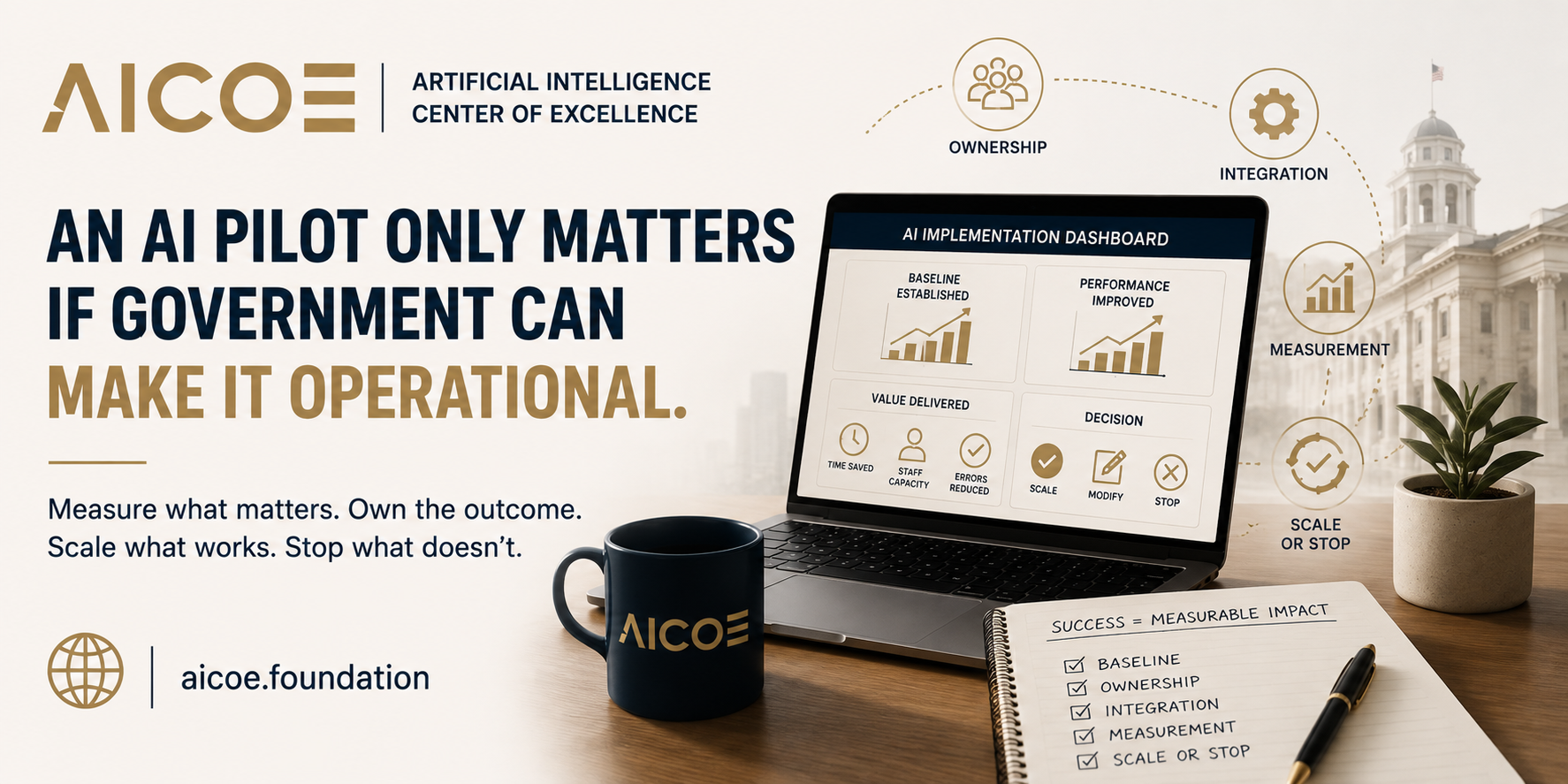
Establish the baseline. Measure the existing process before introducing AI so government has a credible comparison for performance.
Assign ownership. Give a person or department responsibility for the operational outcome, including performance, exceptions and continuing evaluation.
Integrate the capability. Build successful systems into normal workflows, training, budgets, support structures and performance expectations.
Scale or stop. Expand applications that demonstrate value, modify those with fixable weaknesses and end projects that cannot justify continued resources.
Local Government AI Roadmap Series
AICOE's eight-part framework for building AI capability in local government.
- What an AI roadmap for local government actually has to accomplish
- Before government builds an AI roadmap, it needs to know what is already happening
- AI governance has to tell government who can decide what
- Local government needs an AI portfolio, not a collection of pilots
- AI workforce readiness requires redesigning the work
- Government procurement was not built for AI
- An AI pilot only matters if government can make it operational
- How ready is your local government for AI?


%2FNegative.svg)
