
What an AI roadmap for local government actually has to accomplish
Pinellas County’s current AI procurement offers a useful framework for governments trying to turn scattered experimentation into an operating capability.




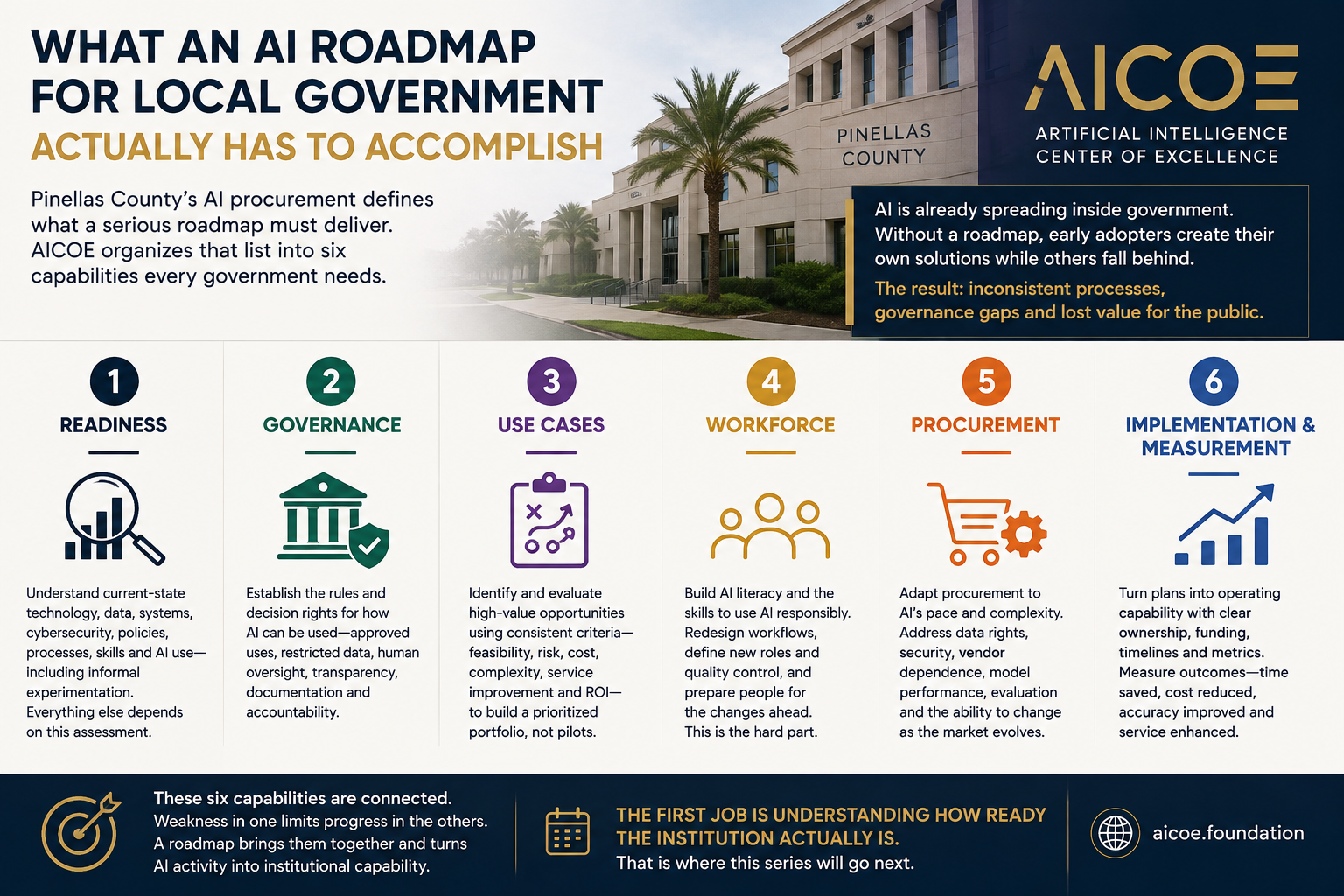
Pinellas County is currently selecting a consultant to develop an enterprise-wide Artificial Intelligence Strategic Roadmap and Governance Framework. The procurement covers the Board of County Commissioners and multiple constitutional and administrative functions and calls for a three-to-five-year roadmap.
The scope is worth examining because of everything Pinellas County expects the roadmap to address. The county calls for organizational readiness, governance and policy, high-value use cases, workforce preparation, procurement safeguards, implementation and measurable return on investment.
Taken together, those requirements provide a useful definition of civic AI readiness.
They also reflect where local governments increasingly find themselves. AI use can spread through an organization before the organization develops a coordinated approach to it. An enthusiastic employee may redesign part of a workflow with AI while someone performing the same function elsewhere continues doing the work manually. One department may experiment aggressively while another waits for formal direction.
That creates operational inconsistencies alongside the more familiar concerns about cybersecurity, public records, privacy and accuracy. Two departments can begin solving similar problems differently. Knowledge developed by one employee may never reach colleagues. Successful experiments can remain isolated. Government can accumulate AI activity without accumulating much institutional AI capability.
A roadmap has to bring those pieces together.
At the Artificial Intelligence Center of Excellence, I think the work can be organized into six areas.
Readiness. Before deciding where AI should go, government needs an accurate picture of where it stands. That includes technology infrastructure, data, integrations, cybersecurity, policies, existing automation, procurement processes and current AI use. It also means finding the unofficial experimentation already happening across departments. This may be the most difficult part of the roadmap because every decision that follows depends on the quality of this assessment.
Governance. Government needs rules for how AI operates inside the institution. Those rules need to address approved uses, restricted data, human review, model selection, transparency, documentation and accountability. Governance also needs an operating structure that determines who makes decisions when a new use case emerges.
Use cases. Governments will have far more potential AI applications than they can responsibly pursue. A roadmap needs a repeatable way to find opportunities and compare them based on feasibility, risk, cost, complexity, service improvement and expected return. That creates a portfolio that can be prioritized rather than a collection of disconnected experiments.
Workforce. This may become the hardest implementation challenge. AI literacy is one requirement. Governments will eventually need to redesign workflows, establish new quality-control responsibilities and determine how AI changes specific jobs. If that work remains voluntary and employee-driven, capability will vary widely even among people performing the same role.
Procurement. AI complicates technology purchasing because models, capabilities and pricing can change quickly. Governments need procurement standards that address data rights, security, vendor dependence, model performance, evaluation and the ability to change technologies as the market develops.
Implementation and measurement. A roadmap eventually has to produce operating systems. Projects need owners, budgets, timelines, performance measures and criteria for continuing, changing or ending them. Government should be able to show whether an AI implementation reduced processing time, lowered cost, improved accuracy or produced a measurable improvement in public service.
These six areas are connected. Weakness in one can limit progress in the others. A workforce cannot implement systems it has not been prepared to use. Procurement cannot adequately evaluate products without governance standards. Leaders cannot prioritize use cases without understanding existing systems and data.
Pinellas County's procurement is a useful local signal because it treats AI as an enterprise capability rather than a software purchase. Florida's cities and counties will increasingly face the same set of organizational questions as AI enters permitting, budgeting, customer service, planning, emergency management and everyday administrative work.
The first job is understanding how ready the institution actually is.
That is where this series will go next.
A Practical Model for a Civic AI Roadmap
Assess readiness. Document the technology, data, policies, processes, skills and AI activity that already exist.
Establish governance. Define authority, acceptable use, safeguards, review processes and accountability before adoption spreads further.
Build institutional capability. Develop a prioritized use-case portfolio, prepare the workforce and create procurement standards suited to AI.
Implement and measure. Assign ownership, fund execution and measure whether each deployment produces meaningful operational or public value.
Local Government AI Roadmap Series
AICOE's eight-part framework for building AI capability in local government.
- What an AI roadmap for local government actually has to accomplish
- Before government builds an AI roadmap, it needs to know what is already happening
- AI governance has to tell government who can decide what
- Local government needs an AI portfolio, not a collection of pilots
- AI workforce readiness requires redesigning the work
- Government procurement was not built for AI
- An AI pilot only matters if government can make it operational
- How ready is your local government for AI?


%2FNegative.svg)
