
Local government needs an AI portfolio, not a collection of pilots
Governments will find hundreds of potential uses for AI. A disciplined portfolio helps leaders decide which ones deserve public resources and institutional attention.




Once a local government understands its AI readiness and establishes governance, another problem appears quickly: there are far more possible AI projects than any organization can pursue.
Pinellas County recognizes this in its current procurement for an enterprise-wide AI Strategic Roadmap and Governance Framework. The county calls for identifying and prioritizing AI use cases based on factors including feasibility, risk, complexity, cost, return on investment and potential improvements to public services.
That discipline is important because AI makes experimentation remarkably easy.
A department can demonstrate an AI application in days. An employee can build a useful workflow in an afternoon. Vendors can arrive with dozens of potential applications. Soon, government can have an impressive collection of pilots competing for attention, funding and technical support.
A portfolio creates a way to decide which experiments should become operating capabilities.
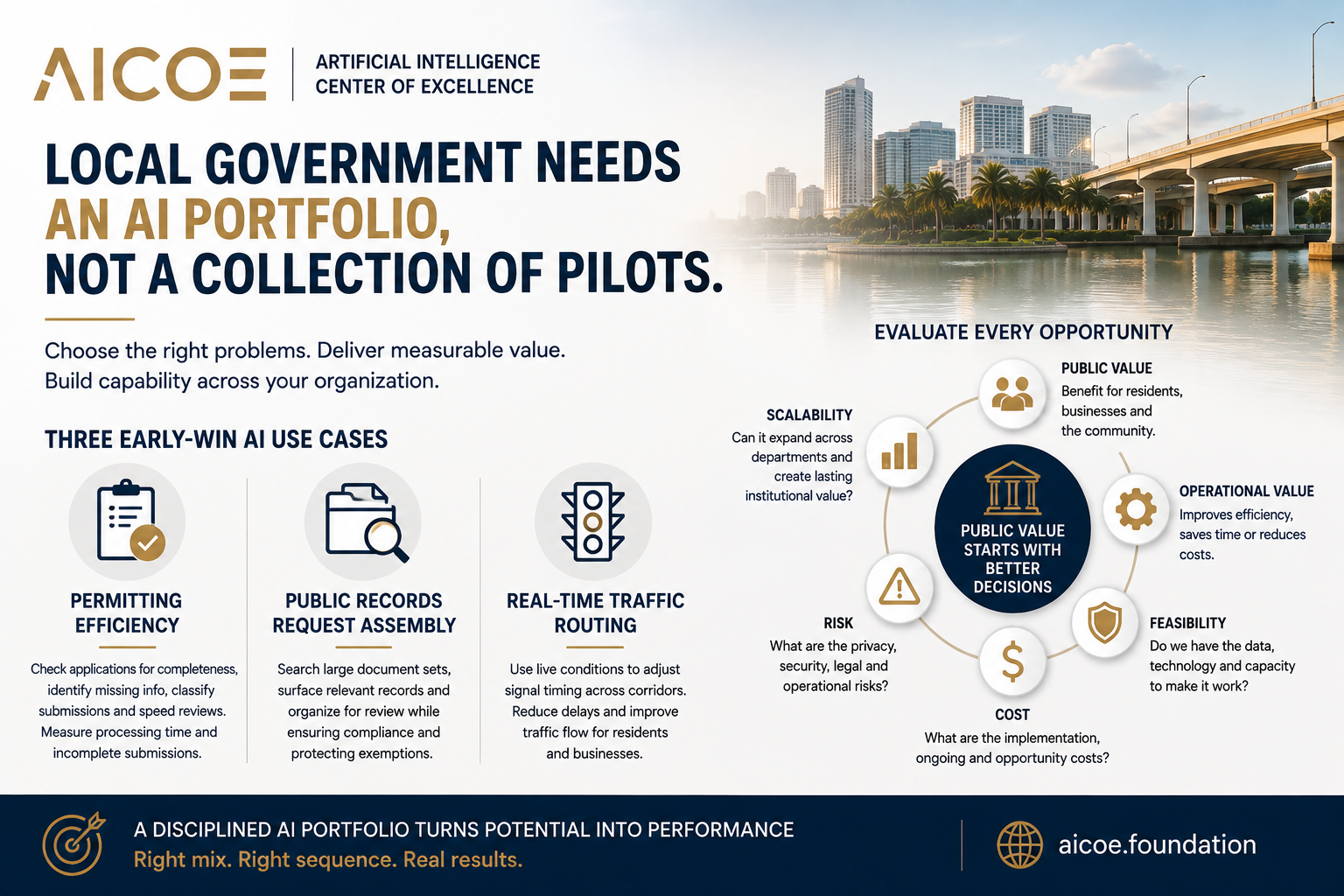
Consider three potential local government applications.
Permitting efficiency sits toward the accessible end of the spectrum. AI can check an application for completeness, identify missing information, classify documents and help staff navigate applicable rules. A government can measure processing time, incomplete submissions, staff hours and applicant experience. The underlying problem already exists and the desired outcome is clear.
Public-records request assembly introduces additional complexity. AI could search large collections of documents, identify potentially responsive material and organize records for review. Human staff would remain responsible for exemptions, redactions and final release. The potential savings could be substantial in governments processing large volumes of requests, while privacy, accuracy and public-records law raise the required level of oversight.
Real-time traffic routing through synchronized signals moves much farther along the complexity curve. An intelligent traffic system could use current conditions to continually adjust signal timing across a network. Success could be measured through travel times, intersection delays and traffic flow. Implementation requires dependable sensors, infrastructure integration, technical expertise and continuous system performance.
All three could create public value. They should not compete for resources simply because someone produced a compelling demonstration.
AICOE's approach would score prospective use cases across six factors.
Public value asks how residents, businesses or the community benefit.
Operational value measures improvements such as staff time saved, faster processing, lower costs or increased capacity.
Feasibility examines whether the technology, data, integrations and organizational capability exist to make the application work.
Risk considers privacy, cybersecurity, accuracy, legal requirements and the consequences of an incorrect output or system failure.
Cost includes implementation, integration, training, maintenance and continuing model or vendor expenses.
Scalability asks whether the capability can expand across a department or organization and whether the investment creates infrastructure useful for additional applications.
The result should be a portfolio containing projects at different levels of complexity.
Several lower-risk applications can generate measurable results relatively quickly while employees gain experience working with AI. More ambitious projects can proceed through longer development, governance and infrastructure processes. Governments can learn from early deployments and apply those lessons to applications carrying greater consequence.
This approach also changes how pilots are evaluated.
A technically successful demonstration does not automatically deserve implementation. Leaders should know who owns the problem, what baseline performance looks like, what improvement they expect, what data the system requires and how the application would move from experiment into normal operations.
Sometimes the correct decision will be to stop.
That discipline becomes increasingly important as AI lowers the cost of creating prototypes. Government's scarce resources remain staff attention, implementation capacity, integration work and public dollars.
A strong AI roadmap directs those resources toward a deliberate portfolio of problems worth solving.
A Practical Model for Selecting Civic AI Use Cases
Define the problem. Start with a measurable operational or public-service problem and establish current performance before evaluating an AI solution.
Score the opportunity. Compare public value, operational value, feasibility, risk, cost and scalability using consistent criteria.
Build the portfolio. Balance accessible, lower-risk opportunities with more ambitious projects that require greater infrastructure, governance and organizational capability.
Graduate successful pilots. Require ownership, funding, performance measures and an implementation path before moving an experiment into regular government operations.
Local Government AI Roadmap Series
AICOE's eight-part framework for building AI capability in local government.
- What an AI roadmap for local government actually has to accomplish
- Before government builds an AI roadmap, it needs to know what is already happening
- AI governance has to tell government who can decide what
- Local government needs an AI portfolio, not a collection of pilots
- AI workforce readiness requires redesigning the work
- Government procurement was not built for AI
- An AI pilot only matters if government can make it operational
- How ready is your local government for AI?


%2FNegative.svg)
