
How ready is your local government for AI?
The AICOE Civic AI Readiness Scorecard gives local leaders a practical way to identify strengths, expose bottlenecks and decide what to build next.




Pinellas County's procurement for an enterprise-wide AI Strategic Roadmap and Governance Framework provided the starting point for this series. Its requirements showed how many parts of government have to move together for AI to become an operating capability.
Over the past seven articles, I have organized that work into six areas: readiness, governance, use cases, workforce, procurement and implementation.
The final step is measuring them.
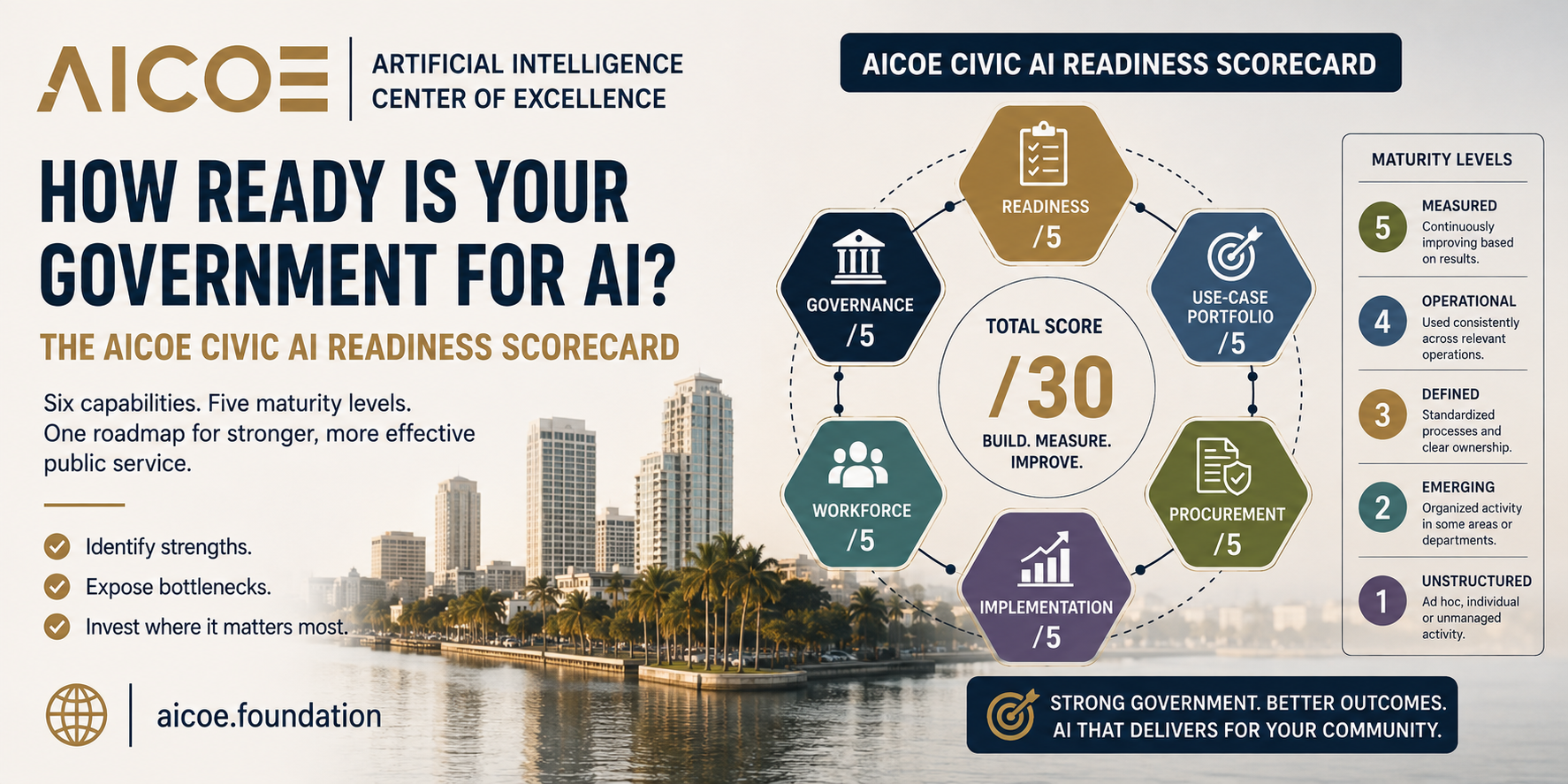
At the Artificial Intelligence Center of Excellence, we've developed a Civic AI Readiness Scorecard around those six capabilities. The objective is to give mayors, county administrators, CIOs and department leaders a practical picture of where their organizations stand and where the next investment should go.
A checklist is insufficient for that job.
Having an AI policy does not establish effective governance. Sending employees through AI training does not mean departments have redesigned work. Running pilots does not demonstrate that government can implement successful ones at scale.
The scorecard therefore measures organizational maturity through observable capabilities.
Each of the six areas receives a score from one to five.
1 | Unstructured. AI activity is largely individual, inconsistent or unmanaged.
2 | Emerging. Organized activity has started, often within individual departments or through isolated initiatives.
3 | Defined. Government has established common standards, ownership and repeatable processes.
4 | Operational. Those capabilities are being used consistently in relevant government operations.
5 | Measured. Government evaluates results and continuously improves the capability based on evidence.
The same maturity scale can then be applied across the six areas developed throughout this series.
Readiness measures how well government understands its technology, data, workflows, workforce capabilities and existing AI activity.
Governance measures whether decision rights, data rules, human oversight, documentation and accountability are established and actually used.
Use-case portfolio measures government's ability to identify, compare and prioritize AI opportunities based on public value, operational value, feasibility, risk, cost and scalability.
Workforce measures AI literacy along with the deeper work of standardizing successful workflows, changing roles and incorporating AI competencies into hiring and employee development.
Procurement measures government's ability to buy AI around outcomes while protecting data, portability, performance and its ability to change technologies.
Implementation measures whether pilots have owners, baselines, operating plans and performance measures and whether successful projects become normal government capabilities.
That produces a maximum score of 30.
I would pay considerably more attention to the six individual scores.
Imagine a county scoring 21 out of 30. That sounds reasonably strong until its profile shows readiness at 4, governance at 2, use cases at 5, workforce at 1, procurement at 4 and implementation at 5.
The workforce score immediately becomes a management issue. The county has identified strong applications and developed the machinery to implement them, but employees and jobs have not been prepared for the resulting changes.
Another government might have excellent workforce preparation and governance while scoring poorly on readiness. Its next dollar may belong in data, systems integration and process mapping.
The profile makes those differences visible.
It can also create a useful annual discipline. Conduct the assessment, establish the baseline, choose the weakest capabilities that constrain progress and reassess a year later.
That gives elected officials and administrators a better measure of progress than counting AI projects.
Local governments will take different routes into AI because their systems, budgets, workforce and communities differ. They still need many of the same institutional capabilities.
The scorecard gives leaders a way to see those capabilities together and decide where their organization needs to get stronger next.
A Practical Model for Using the Civic AI Readiness Scorecard
Score the six capabilities. Assess readiness, governance, use cases, workforce, procurement and implementation from one to five using observable organizational evidence.
Find the constraint. Examine the individual scores and identify weaknesses capable of limiting progress elsewhere.
Invest against the gap. Direct leadership attention, funding and organizational work toward the capabilities creating the greatest constraints.
Measure again. Repeat the assessment regularly and use changes in the readiness profile to evaluate institutional progress.
Local Government AI Roadmap Series
AICOE's eight-part framework for building AI capability in local government.
- What an AI roadmap for local government actually has to accomplish
- Before government builds an AI roadmap, it needs to know what is already happening
- AI governance has to tell government who can decide what
- Local government needs an AI portfolio, not a collection of pilots
- AI workforce readiness requires redesigning the work
- Government procurement was not built for AI
- An AI pilot only matters if government can make it operational
- How ready is your local government for AI?


%2FNegative.svg)
